
Most seasons in my life, I have lived close to the sea. Casting my gaze upon the Pacific Ocean was a daily occurrence, and yet only rarely did I ever dare to enter into the waves. It was not until my arrival to the coast of Northern Ireland that I took to swimming in the sea. Within days of my arrival to this new place of living, a lovely individual who was departing extended an invitation to join her for what would be her final swim in the North Channel, between the Atlantic Ocean and Irish Sea. I am filled with gratitude for this invitation, for sea swimming has since become a cherished practice that provides deep nourishment each day I encounter the water.
Swimming in the cold water of the North Atlantic brings an extraordinary sense of enlivening to my days, which are currently spent at a center for peace and reconciliation. Immersing myself in this place of lumpy crossings, I have found swimming in the sea to bear insight into the processes and practices of building peace.

Engaging in Risk
Even when one takes precautions, attentive to the speed of the current, the height and frequency of the waves, or the presence of a riptide, swimming in the sea entails risk. The waters hold much mystery and tremendous power. On rough days, moving into the waves, beyond where feet can graze the sandy seafloor, it is all too easy to be drawn down the beach or out toward deeper depths. These factors accompany the risk involved in immersing oneself in the cool waters of the North Atlantic Ocean.
In his book The Moral Imagination: The Art and Soul of Building Peace, John Paul Lederach (2005) offers four disciplines of peacebuilding, one of which is a willingness to risk. Engaging in peacebuilding, there are myriad threads of engagement that necessitate risk taking. In a community or context for which violence and conflict are the norm, to even choose the path of peace is a risk, the cost for which can be someone’s life. For those engaged in the practice of peace, acquainting ourselves with our own relationship with risk is an important process. For many acquainting oneself with risk is not a choice, as risk is a daily feature of life. When the opportunity avails itself to explore one’s relationship with risk, however, not only is deep insight gained into one’s embodied physical and emotional landscape, so too does it build one’s capacity to engage in risk.
Uniqueness of Encounter
Each day I swim, I arrive to the same place on the beach, very often at the same time, and no two encounters are the same. The weather and the sea are incredibly variable whereby one day, the water is as calm as a lake and the next day (or even a few hours later), the water is turbulent and frothing. In addition to the changes in the weather and the water, the state of my own physical, mental, and emotional landscapes profoundly shapes my experience. The countless elements that create the experience of a swim interact and weave together uniquely each day such that every encounter with the sea is unique unto itself.
Such uniqueness of encounter is a present aspect in peacebuilding, the process of which is centered on and guided through relationships. In building and sustaining relationships over time, it is vital to remember that each encounter is unique, even if it is with the same individual or group over time. Conflict is dynamic, even if sustained over decades. Between one encounter and the next, entire worlds may have been turned over for the individuals involved. These changes in life need not be extreme to have profound impact on the process of building trust and deepening relationship. Living on the day to day, we all are acquainted with the ways in which we experience shifts in our embodied experience, our emotional landscape, and the movement of our thoughts, shaped by the happenings of our own lives and the lives of those around us. The dynamism of the intrapersonal, interpersonal, and external landscapes shapes the uniqueness of each moment we inhabit. Recalling this, we are called to approach each encounter in the process of building transformative relationships in all its uniqueness, holding space for all that may have changed between one meeting and another.
Noticing Nuance
In being present with the uniqueness of each encounter with the sea, I’ve noticed myself noticing differently. Casting my gaze upon the water, I find myself more attuned to different aspects of the water: the shape of the waves, the speed with which they arrive, the differing textures along the water’s surface brought forth by the wind or currents moving beneath. When swimming in the water, I experience a different quality of awareness of my own body. The sensations on my skin are more acute, as I feel my body responding to the cold water. The cold does not impact my body in a uniform way, such that I feel different parts of my body responding to the cold in a distinct way, and these sensations are in a constant state of change. I also notice my breath in a heightened way, as I center my attention on my breath to support my body’s adjustment to the water’s temperature. Sea swimming thus supports a different quality of noticing, deepened over time and enhanced by the intensity of the experience.
Noticing differently and noticing nuance are practices that greatly support in peacebuilding. Recalling Lederach’s work once more, he speaks wisely on the value of a deep practice of noticing to support peace practitioners relative to themselves and the work they do. Whether it’s noticing whose voices are present in a conversation and whose are absent, the subtly of someone’s reaction to a comment, or the ways in which separation and segregation are subtly or overtly signaled in a town, keen attention and awareness across interpersonal and external landscapes is essential to guide a deeper understanding of a conflict context. An ability to notice differently creates the opportunity to notice and illuminate something that may prove to be a pivot point in a conflict and support movement toward peace.
Not only does noticing enhance the externally oriented process of building peace, noticing differently within is supportive for peace practitioners to navigate through geographies of conflict. Through becoming more attuned to the ways in which our bodies react in and to different contexts, we can better cultivate an ability to respond with a discerning pathway of behavior. For example, if in a challenging conversation I begin to notice my heart rate increasing, my breath shallowing, and a hollowness developing in my stomach, I can choose a slower breath and ground through my feet to support a settling in my body. I can continue to engage in the conversation from a space of grounding, rather one of reactivity, facilitated by my ability to notice the subtle shifts unfolding in my inner landscape.
Importance of Partnership
Most mornings, my swims occur in partnership. With another friend who finds joy in the sea, we embark together to the shore for a sunrise swim. We often join or are joined by other people from town, who likewise begin their days in the ocean’s embrace. Swimming together provides an opportunity to connect and build relationships, and also an additional source of encouragement to swim on particularly cold, windy, or wavy mornings. The support gives such warmth and additional joy to the experience.
Peacebuilding unfolds through relationship. Far from an individual act, movement toward peace can only occur through and in connection with others. Centering relationship not only bolsters the sustainability of one’s practice, it also extends the impact of one’s efforts. Whether in a mediative capacity and supporting the development of relationships, facilitating healing and the support of (re)connection, or otherwise, peace practitioners navigate a wide breadth of relational engagement. Remembering and affirming relationship thus is simultaneously the process and result of the practice of peace.
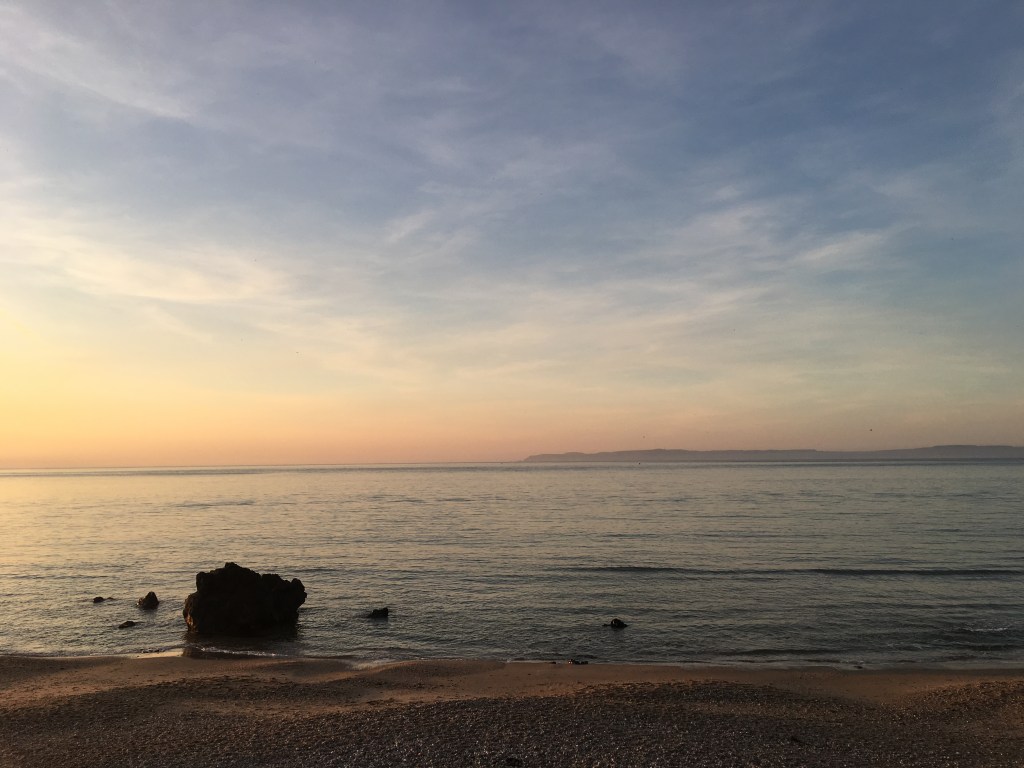
The sea is a powerful and mysterious force. It is dynamic, ever-changing, and commands deep respect. In having deep respect for the sea and honoring its power, this does not mean avoidance, rather it is through gentle and reverent encounter that profound transformation unfolds. Embracing the risk, being present to the uniqueness of each encounter, noticing in a nuanced way inwardly and outwardly, and facilitating relationships, swimming in the sea offers insight for transforming ways in which we encounter others and encounter ourselves on the pathways we traverse toward peace.
© 2019 All Rights Reserved

 Embody Peacebuilding
A wonderful experience shared so eloquently. I am always humble to the sea in the presence of her immense strength verses my minuscule nature of being. It’s wonderful to share those experiences and the bonds that are created as a result are unique. Enjoy the sea through the seasons and days and hours. Every wave is a new one, never to be repeated.
LikeLike