On Critical Embodied (Self) Reflection

Wherever you are reading this, you are invited to pause and notice. To notice where you are, the space you are in. To notice how you are – how you are feeling physically, how you are feeling emotionally. To notice how your breath is moving. As you notice, perhaps you sense a shift you can make to feel more comfort in this moment. That may be choosing to adjust your posture, to draw a deeper breath, or anything else you need.

A navigation of conflict that moves toward the building of peace asks of peacebuilding practitioners the cultivation of different lenses of perception, different ways of seeing and interpreting.i That may be in a micro-level context of an interpersonal conflict or a macro-level context of regional and societal conflict dynamics. Perception is enabled through the body, and yet attending to the body as the site of perception and expression, as well as the container for our experiences is often neglected amidst the urgencies and complexities of peacebuilding. There are many reasons for this neglect – it may, for example, emerge from cultural conditioning that places embodied awareness as secondary to cognitive knowledge, or from experiences of trauma through which attending to the body has come to feel unsafe. Honoring this, I would like to suggest that cultivating embodied awareness is of tremendous value for peacebuilding practitioners, an awareness that emerges from practicing ‘critical embodied (self) reflection.’ This series of terms, which will be explored in reverse order in the paragraphs to follow, offers a pathway through which practitioners can move with greater presence, (self) awareness, and intentionality.

(Self) Reflection

The field of peacebuilding has increasingly come to acknowledge the importance of reflective practice to support individual practitioners as well as initiatives and organizations in their work. In Reflective Peacebuilding: A Planning, Monitoring, and Learning Toolkit, authors Lederach, Neufeldt, and Culbertson offer an exploration into and guidance for reflective practice that allows for peacebuilding practitioners to clarify the theories of change that guide their work. Reflective practice is defined as “building knowledge, understanding and improvement of practice through explicit and disciplined reflection.”ii Such an approach to reflective practice is essential for peacebuilding practitioners to inform the work in which they are involved.

There is another dimension of reflective practice that is less attended to, which I here describe as (self) reflection.iii From a more individualist orientation, this dimension of reflective practice focuses on the qualities of the relationships one has with oneself and with others. It involves being attentive to what is present in your relationships with yourself, others, and the spaces you are in. Such (self) reflection emerges from a space of compassionate curiosity and is enacted through noticing and care.iv It involves both “reflection on practice,” taking time and space apart to reflect, and “reflection in practice,” being present in the midst of a given process as it unfolds.v There are different avenues of noticing you might choose to follow, including noticing the patterns of your thoughts or noticing patterns of emotion. I would like to now turn to our next word within ‘critical embodied (self) reflection’, to explore the value of centering the body in reflective practice.

Embodied

As human beings, we cannot escape our embodiment. Even for people in experiences of deep trauma who sense numbness and disconnection from their bodies and their beings, so long as we are alive, we navigate life through our bodies. Our bodies are the vehicles through which we sense, perceive, and act. There are many different ways embodiment may be understood, particularly so across different cultural contexts. For the purposes of this article, I define embodiment as “attending ‘with’ and attending ‘to’ the body.”vi Embodied (self) reflection thus entails reflection that notices what is present in the body and notices with the body. Honoring the present-moment nature of embodiment, I will focus here on “reflection in practice.”

For example, when I am participating in a discussion, I may perceive a range of dynamics in and with my body. ‘Noticing in’ my body emerges from an attention that is turned inwards. I may sense into a variety of different things, for example my posture or the sensations and emotions I am experiencing.

Posture

Am I seated or standing?
Is my posture open or closed?
Is my back hunched or am I sitting tall?
Sensation / Feeling


What sensations am I feeling (e.g., do I feel tingling, tightness, warmth, coolness, etc.)
Where am I feeling these sensations in my body? (e.g., do I feel tingling in my stomach, tightness in my shoulders, coolness in my hands, etc.)
Emotion
What emotions am I experiencing?
Where am I feeling these emotions in my body?
Inquiries into noticing in my body

Noticing with my body emerges from an attention that bridges the inner and the outer, particularly through the senses.

Seeing
What am I seeing in the space?
How are the people in the space holding themselves? (e.g., their posture or level of engagement)
What is the quality of light in the space?
Touching / Sensation
What energy do I feel in this space generally? (e.g., is there tension, is there engagement and alertness, is there tiredness, etc.)
What energy do I feel from each person in the space?
How am I receiving this energy?
Where do I feel this energy in my body?
How is the energy shifting over time?
Hearing
What sounds do I hear in this space?
What is being said? What is not being said?
Who is speaking? Who is not speaking?
What are the qualities of the silences (e.g., are they reflective, spacious, tense, or anticipatory)?
Inquiries into noticing with my body

Noticing in and with the body enables present moment awareness to what your current experience is, informed by your internal and external environments. This awareness, in turn, enables you to move with greater attention and intention to respond to what is arising in a given circumstance. Additionally, it is said that “what you pay attention to grows.”vii In attending with and to the body, the breadth, depth, and nuance of your awareness grows. Sensitivity to subtle cues felt through the body is an invaluable capacity for peacebuilding practitioners to sense and notice what might be overlooked by others and may hold the key to transforming a conflict dynamic, whether at the micro level of interpersonal relationships or the macro level of society.viii

An element of embodiment that is important to acknowledge is the ways in which our bodies hold the echoes of our pasts, lived, and inherited. What we sense and the meaning we make of that sensory information is shaped by our interpersonal relationships, cultural upbringing, and intergenerational trauma and resilience. In working across division, real and perceived, it is important to remember that not only is your perception and embodied experience shaped by these forces, so too are the perceptions and embodied experiences of those you are working alongside. This brings us to the final word of ‘critical embodied (self) reflection’ and dynamics of power and identity expressed through the body and in our relationships.

Critical

A critical lens in embodied (self) reflection draws on the notion of critical consciousness developed by Paolo Freire, which invites an analysis of power dynamics within and across relationships from the micro level of interpersonal relationships to the macro level of societal relationships.ix It also invites a turn inwards, to identify the ways in which we internalize the systems and structures of power that shape the societies in which we live. These power dynamics inform our intersectional identities and relationships across all forms of identity such as race, class, gender, (dis)ability, sexual orientation, religion, and language, in other words, our positionality.x, xi Our positionality is therefore dictated by the identities our bodies express, and our bodies, in turn, are shaped by the power dynamics in the societies we live in.xii 

For example, I identify as a white-bodied woman. Living in the highly racialized society of the United States where white-bodied people are highly privileged, I embody dimensions of this privilege that I must be attuned to so as to navigate them with honesty and respect with each person I encounter.xiii As a woman living in a patriarchal society, I also embody dimensions of marginalization that I similarly must be attuned to so as to navigate them with compassion and dignity. Thus, the critical lens of embodied (self) reflection invites a consideration of the dynamics of power, privilege, and marginalization that we hold and express in our bodies, and how they shape our relationships.

This awareness is particularly important for peacebuilding practitioners who seek to transform structural violence, but also embody dimensions of the very violence they seek to transform. Critical embodied (self) reflection is a practice of sensing into and making visible the invisible and internalized patterns of violence we hold in our bodies. For people who are particularly marginalized, an early cultivation of this awareness is a function of survival. For people who are particularly privileged, their privilege affords an ignorance to and distancing of this awareness. For practitioners, it is important to hold this awareness in body and in mind in relationship with oneself and in relationships with others so as to navigate these relationships in a way that furthers the building of peace. 

Integrating the Threads: Critical Embodied (Self) Reflection

In the paragraphs above, we have explored the elements of critical embodied (self) reflection in reverse order, considering the value of each element for peacebuilding practitioners. ‘(Self) reflection,’ centered in compassionate curiosity, is practiced through noticing with care. ‘Embodied’ directs the practice of the noticing to and through the body. ‘Critical’ contextualizes what we notice in and with the body within our respective social, political, and historical contexts, and particularly how we are positioned within them. These elements are unified through the threads of presence, (self) awareness, and intentionality. Through cultivating caring presence, we are able to become more aware (of ourselves, others, the contexts we are in), and thus we can move with greater intention in our relationships. These subtle qualities are invaluable for peacebuilding practitioners to cultivate so as to enhance support for themselves, their relationships, and their visionary work of building peace in a fractured world.

Before clicking away to a new page, you are invited to pause and notice. To notice where you are, the space you are in. To notice how you are – how you are feeling physically, how you are feeling emotionally. To notice how your breath is moving. Do you notice something differently from what you noticed before? From what you are sensing and feeling, you are invited to make any adjustments to experience a bit more comfort, just for this moment. May you go well.


References

Acarón Rios, Thania. “The Practitioner’s Body of Knowledge: Dance/movement in Training Programmes that Address Violence, Conflict and Peace.” Master’s thesis, University of Aberdeen, 2015.

Caldwell, Christine, and Lucia Bennett Leighton. Oppression and the Body: Roots, Resistance, and Resolutions. Berkeley, CA: North Atlantic Books, 2018.

Fogel, Alan. Body Sense: The Science and Practice of Embodied Self-Awareness. New York, NY: W.W. Norton & Company, 2013. Gray, Amber. “Staying Present: The Body


i John Paul Lederach, The Little Book of Conflict Transformation: Clear Articulation of the Guiding Principles by a Pioneer in the Field (Intercourse, PA: Good Books, 2003), 7.

ii John Paul Lederach, Reina Neufeldt, and Hal Culbertson, Reflective Peacebuilding: A Planning, Monitoring, and Learning Toolkit (Notre Dame, IN: Joan B. Kroc Institute for International Peace Studies, 2007), 2.

iii I place self in parentheses to honor the ways in which different cultures and traditions hold different understandings of the ‘self’ in relation to worldviews that span from more individual to more collective in orientation. 

iv John Paul Lederach has referred to such a practice as the ‘innerworks’ of peacebuilding. For examples of his elaboration into the innerworks, please see ‘Thoughts on a Penny – Challenges to Creative Conflict in the Public Square’ or ‘Compassionate Presence: Fait-based Peacebuilding in the Face of Violence.’

v Schön, Donald A. The Reflective Practitioner: How Professionals Think In Action. New York: Basic Books, 1983.

vi Thomas J. Csordas, “Somatic Modes of Attention,” Cultural Anthropology 8, no. 2 (1993): 138.

vii adrienne maree brown, Emergent Strategy: Shaping Change, Changing Worlds (Chico, CA: AK Press, 2017), 42.

viii Nadja Alexander and Michelle LeBaron, “Embodied Conflict Resolution: Resurrecting Roleplay-based Curricula through Dance,” in Educating Negotiators for a Connected World (St. Paul, MN: DRI Press, 2013).

ix Paulo Freire, Pedagogy of the Oppressed (New York, NY: Bloomsbury Academic, 2018).

x The term ‘intersectionality’ was originally coined by Kimberlé Crenshaw to describe multiple burden of marginalization and discrimination of Black women who experience both racism and sexism, whose “intersectional experience is greater than the sum of racism and sexism.” Crenshaw, Kimberlé. “Demarginalizing the Intersection of Race and Sex: A Black Feminist Critique of Antidiscrimination Doctrine, Feminist Theory and Antiracist Politics.” University of Chicago Legal Forum 1989, no. 1 (1989): 139-67.

xi Monisha Bajaj and Edward J. Brantmeier, “The Politics, Praxis, and Possibilities of Critical Peace Education,” Journal of Peace Education 8, no. 3 (2011).

xii For more on this theme of embodiment, power, and oppression please see My Grandmother’s Hands: Racialized Trauma and the Pathway to Mending Our Hearts and Bodies; Oppression and the Body: Roots, Resistance, and Resolutions; and The Politics of Trauma: Somatics, Healing, and Social Justice.

xiii Rae Johnson, “Grasping and Transforming the Embodied Experience of Oppression,” International Body Psychotherapy Journal 14, no. 1 (2015).

© 2021 All Rights Reserved

On Beauty

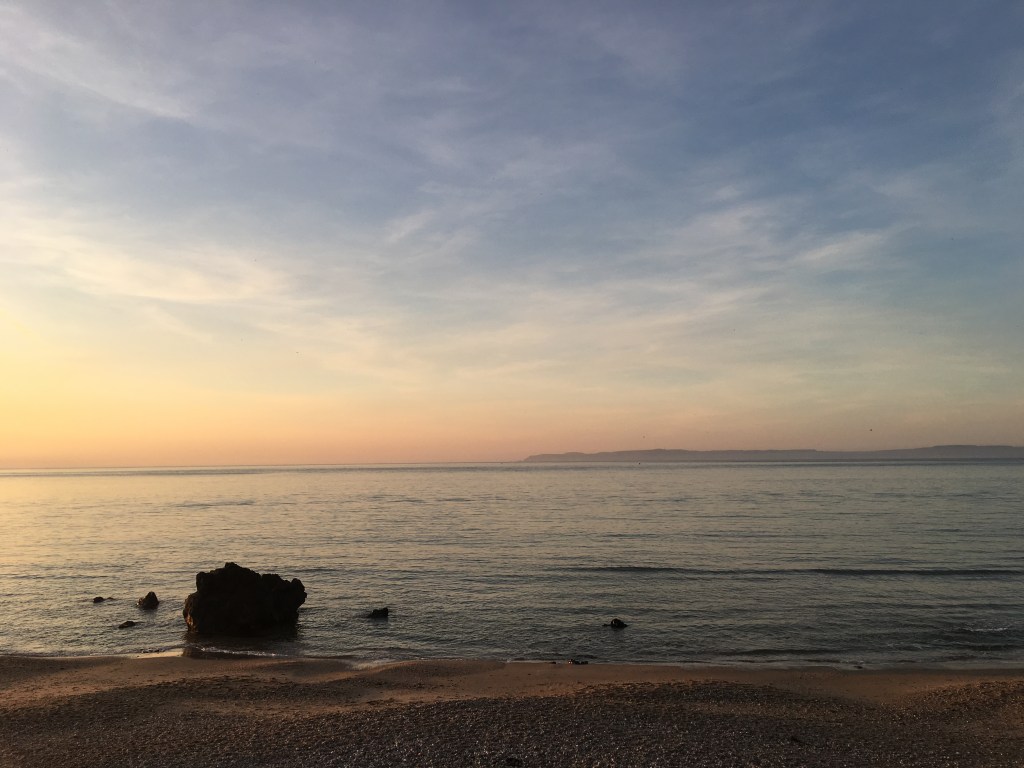
Casting my gaze toward the setting sun, I watch the illuminated horizon beyond a familiar coastline. Bright yellows and oranges emanate from the fiery orb. As the light shines upward, it creates an ombre sky, from glowing gold to pastel yellow to a clear blue darkening with each passing moment. As the light cascades downward, it brightens the ocean in a dynamic watercolor dance. Nearing the coastline of jagged rocks and sand softened beach, the sun’s rays are filtered through the mist of crashing waves. The air is swirling and opaque. Feeling the cool moisture of the ocean air and gentle breeze caress my skin, I find myself curious.

This moment, this sunset, this landscape, objectively speaking, it ‘should’ be beautiful. Yet, as I cast my gaze outward, I do not perceive beauty.

Following my curiosity, I allow my imagination to transport me to landscapes I have visited, vistas that left me speechless in their splendor. Inhabiting these landscapes in my imagination, I notice a shift in my body. To share words so gracefully woven together by Prentis Hemphill, something rearranges itself within me. I notice an easing in the space around my heart, a softness unfolding through my belly, and a brightness in the quality of my thoughts. I allow myself to rest for a moment in the nourishing warmth of these sensations.

Returning to the space of the setting sun before me, these shifts rearrange themselves once again. A dull numbness and bracing envelop me.

From the physical landscape, I turn my attention to my mental and emotional landscapes. I sense the layers of sadness, disconnection, and disjuncture that have accumulated over a tumultuous year. I sense the grief of farewells imposed too early and goodbyes that remain unsaid. I sense the confusion of returning to a place that I once felt held and at home, and now feels hollow and strange.

Becoming present to the layers of experience that filter my perception, I learn a quality of beauty.   

Beauty is a felt

sense, resonance between worlds

inner and outer.

Beauty is a deeply embodied and felt experience, a harmonious resonance that emerges from the inter-relationship between our internal landscape and that which we perceive. Our sense of beauty is as much reflective of our inner landscape as our outer landscape. In the moments when these landscapes harmonize, beauty unfolds, an intimate and boundless experience of nourishment and loving embrace.

Honoring beauty as emergence and relationship, I find myself curious.

How can we orient to the world around us to enliven the possibility to experience beauty?

How can we practice noticing differently to create more opportunities for beauty to emerge?

How can we tend to our internal landscapes so as to be receptive to moments of resonance with the outer world?

How can we be in relationship with ourselves to recognize the spark of beauty that lies within?

May we each be enfolded in and nourished by beauty’s embrace.

© 2021 All Rights Reserved

On Simple Things

The journey of healing is a fractal and spiral shaped practice. In our individual paths of healing, we twist and turn, return and try again, catching ourselves in the process of finding new ways of being with ourselves, with others, with the world. Collectively, these twists and turns are long and slow, shaped by and shaping of the interweaving of our individual healing paths. As these paths encounter one another, they may form a strengthened and deepened trail of connection and care. As these paths encounter one another, there may be disjuncture, wound meeting wound such that harm is enlivened and created amidst attempts toward repair. The journey of healing is a painful process.

Like a stone dropped into a pond creating ripples that extend outward, trauma gives rise to patterns of thought, behavior, and emotion that shape how we are in our bodies and our relationships. It is rare that the surface of a pond is perfectly still, absent of lingering ripples from stones dropped in the past or undisturbed by incoming streams or even the gentlest of breezes. We inherit the patterns of our predecessors, passed down through the generations. We develop patterns through our encounters with others, and through our navigation of this world.

Honoring the constant of change, the journey of healing is not one of achieving perfect stillness. Rather, it is one of finding and returning to a sense of steadiness through the tumult. It is the cultivation of the ability to practice discernment around the patterns that shape our individual and collective bodies. It is the nurturing of the ability to discern and choose helpful perspectives and actions, rather than perpetuating a pattern that may (have) become a source of harm. Part of this process involves presencing to the harms we have incurred, and the harms our hurt may have led us to inflict, as we trace the ripples of our wounding back to their source.

Navigating through conflict and orienting toward healing, we are called to practice noticing. To notice our patterns. To trace their source and their reach. As we seek to develop discernment around and transform our patterns, it is helpful to develop a practice of honoring the little things.

Sometimes we enter into practice. Sometimes the practice enters into us.

These months, I am noticing a pattern in my conversations, variations of a phrase that is written, uttered, read, and heard time and again.

‘it’s the simple things’

‘a practice of small wins’

‘it’s all about the little things’

Noticing this pattern, I become present to the healing and radical practice these words offer.

As we move along the spiral path of healing, our trajectory is shaped by a practice of noticing the little things. We begin to notice and come to know our patterns, how they enact themselves in even the smallest of ways in our thoughts, emotions, behaviors, and relationships. From this noticing, we can begin to shift, to make choices that move us in the direction of healing. These choices, these small wins, are reflective of our discernment, agency, commitment, and supports provided by our communities of care.

A practice of noticing the little things is one of resilience. We come to recognize even the smallest sources of joy, delight, nourishment, and love in our lives that, like stars dotting a night sky, offer illumination through seasons of darkness.  

A practice of honoring the little things is one of resistance. It defies a dominant culture that celebrates excess, grandeur, and large leaps of change. Amidst systems that seek to marginalize and dominate, such a practice resists the oppressive cloak of violence and silence, asserting joy and love as sources of and pathways to liberation.  

As we journey individually and collectively along spiral and fractal shaped pathways, centering the little things allows us move in harmony with the pace of change itself.

May we come to know and notice our patterns.

May we cultivate discernment.

May we choose ways of being and relating that orient us toward healing.

May we be compassionate with ourselves and others in our individual and collective journeys of healing.

May we experience moments of steadiness and ease.

May we enter a practice of celebrating the little things.

May we allow this practice to enter us.

© 2021 All Rights Reserved

Arboreal Resilience

Moving along paths that meander through a sequoia forest, I delight in the nourishment the space offers to my senses. Feeling the clay earth beneath my feet, softened with newly fallen leaves and branches, echoes of a recent storm. Hearing the gentle whisper of water flowing in a nearby stream. Receiving cool, damp air into my lungs, laden with the fragrance of life renewing itself on the forest floor. Relishing in the colors and contrast that fill the space: emerald moss blanketing rock faces; amber oak leaves and auburn sequoia needles underfoot, the bright jade of new growth extending from branch tips, not yet darkened by the seasons; and inky shadows tucked into the pleats of tree trunks.

Navigating the forest floor, I cast my attention from the smooth crest of a new fern unfolding from the soil to the towering canopy of trees hundreds of years of age. I listen for lessons of arboreal resilience. 

Burls and Wounding

When a tree has been wounded, when a branch is cut or the trunk damaged, the tree adopts a new pattern of growth around that space. The burl that grows in swirls and lumps is a wood stronger than that of the rest of the tree. In enveloping its wounding, a tree finds a new strength.

How might we learn from the wisdom of burls? How does this wisdom live in us?

When we experience wounding, physical or emotional, we develop new patterns of protection around the space of injury. In the case of a physical wound, our cells coordinate to promote repair. When a bone has broken and is supported to heal, it knits itself back together and that area of bone becomes denser, stronger than it was before. In the case of emotional injury, we develop adaptive mechanisms to navigate and protect ourselves from the harmful dynamic. These mechanisms are myriad and may look like heightened sensitivity to the body language of others to detect potential threat, difficulty trusting others and/or oneself, or disconnection from one’s internal landscape because that space has been filled with too much pain. These processes occur through the innate wisdom of our somas to enable our survival. Such adaptive mechanisms may be helpful for immediate survive, however over time they may deepen into patterns that become harmful to ourselves and people in our lives.

To facilitate healing, conditions must be created in which repair and transformation can take place. If a bone is broken, to heal the physicality of the injury, it is most supportive to set the injury in a cast so the body can be undisturbed as the wound mends. Creating a supportive and nurturing environment in which we can address and transform wounding in our somas is a more complex endeavor.

Perhaps people in our lives are unwilling to create space for or recognize our healing. Perhaps the wound is too raw or too deep, and more time is needed before we are ready to engage in healing work. Perhaps the layers of stress in our lives are currently too numerous and too heavy such that our resources must be allocated toward making it through each day, not delving into wounds we carry. If external and internal conditions arranged in a way that devoting effort toward healing is possible, staying steady on a healing path is an arduous practice in itself. The self-protective patterns we have developed and no longer serve us are powerful, they may be the only way in which we have come to know safety. The journey of healing is one of spiral form, a circling path. With slight adjustments in each rotation, we gain new perspective and train new helpful patterns of being within ourselves and with others. 

Through our experiences of wounding and healing, how might we attend our spaces of wounding in such a way that, like a burl grows on a tree, envelopes the injury with care? How can we engage in our healing in a way that does not attempt to resolve or erase our experiences of injury, but enfolds them with strength and adaptive patterns of growth? How might we nurture slow, steady, spiraling integration of our wounds as parts of our beings?   

Navigating Loss in Collectivity

The growth of a sequoia is one of encircling community. This is particularly pronounced when an elder tree has been felled. Around the severed trunk, new trees sprout forth. The loss of the mother tree creates space for new growth, not just of one new stalk, but many.

What might we learn from the wisdom of encircling community? How does this wisdom live in us?

The emergence of encircling community in the wake of loss is reflective of our individual and collective responses through grief. In teaching about the nervous system, our primary responses to threat are often named as: fight, flight, freeze, and fawn. A fifth response exists that is less commonly named: flock. In the shadow of the loss of a loved one or a large-scale disaster, as humans we find solace and shelter in community. Our coming together, at wakes, funerals, and through other forms of ritual, creates spaces where we can be supported ourselves and support others. As a collective gathered in shared grief, we find resonance in the emotional experience of those around us. Such rituals allow us individually and collectively to begin to integrate the deep heart wound that is the loss of a loved one.

The importance of gathering in the wake of loss has been brought into sharp relief particularly during these difficult months of isolation due to the COVID-19 pandemic. Too many lives have been lost, most of whom have passed away alone, unaccompanied by their loved ones. For the family members, friends, and communities who survive, they are unable to gather in their grief, to come around one another. The healing journey through grief is thwarted, as the rituals we turn to are no longer safe or permitted.

The COVID-19 pandemic has wrought immeasurable pain for millions of people. So too has it illuminated strength in and of community. Through seasons of self-isolation and physical distancing, mutual aid networks emerged and strengthened. In response to the threat of COVID-19, exacerbated through social structures that place black and brown bodied people and impoverished people at particular risk, communities find protection and support through coming together. Communities have mobilized in care to ensure community members’ needs would be met, particularly those most vulnerable.

Through our navigation of trauma and potentially traumatic events, how can we find support in community? Whereas trauma isolates, fragments, and disconnects, how can we nurture spaces and communities of care to extend support to one another, particular our members who are suffering? In a society that praises individualism and discourages vulnerability, how can we be radical in our collectivities and the authenticity of our communication of how we are (when it is safe to do so)? How can we engage in healing processes that help us re-member ourselves, individually and collectively?

Discerning Inspiration

Through the process of photosynthesis, trees and other plants absorb light, water, and carbon dioxide, transforming these elements into oxygen and chemical energy that is stored in the plant for food. This chemical energy is stored in the form of carbohydrates, contributing to the cellular structure of the plant. It is in absorbing light, water, and carbon dioxide from the external environment, a discerning inspiration, that trees and plants are given the necessary energy to grow.

What might we learn from the wisdom of the discerning inspiration of photosynthesis? How does this wisdom live in us?

We are shaped by the environments in which we are raised and the environments in which we live. This includes factors such as our familial culture, dominant societal culture, epigenetics (the way in which our ancestral history lives in our bodies), the physicality of our environment, and many more. As we navigate through life, there are factors influencing us about which we are aware to varying degrees. The extent of our awareness is often reflective of our societal positioning. The nature of privilege and oppression is that they obscure the very structures by which they operate and suppress a questioning of these structures by those who benefit most from their existence.

In the United States, a powerful factor that shapes the social, political, and economic environment is that of white-body supremacy. This form of violence, which, as Resmaa Menakem shares, is not a question a race, but a question of belonging in humanity, weaves through the structures and relationships that constitute this country. To the extent that it is part of the environment in which we live, without an awareness of how white-body supremacy works on us and through us, we continue to inhale and enact the values and practices it upholds.

Through increased awareness of the factors that shape our environment, and thus shape us (such as white-body supremacy), we can become more discerning about what we absorb and integrate into our somas. In photosynthesis, a plant does not absorb every element in its environment – it absorbs that which it can integrate and will support its growth. How might we invite the same discernment in that which we absorb and integrate into our beings? How might we recognize what in our environment nurtures our growth and what impede connection and perpetuate harm? How might we be discerning about what we have absorbed, integrating only that which nourishes our individual and collective flourishing, and expelling that which does not serve us?

On Arboreal Resilience

Opening to the wisdom of the trees, the teachings of arboreal resilience are many. As we are of nature, this wisdom is inherent within us as well. May we look to the world around us for guidance to remember the depth of knowing we hold within our individual and collective bodies.

Arboreal resilience reminds us how we can tend to our wounds with patience and strength.

Arboreal resilience reminds us how we can and do turn to one another to navigate through moments of difficulty, of loss and of disaster.

Arboreal resilience reminds us that we can be discerning about how we are shaped by the world we inhabit.

Arboreal resilience reminds us that this knowing is not a construct of the mind, but a wisdom held in the fiber of our beings.

May these reminders support us in co-creating a world that centers healing, community, and belonging.

tend arboreal

resilience. adaptive

growth, patient and strong.


References

adrienne maree brown, Emergent Strategy: Shaping Change, Changing Worlds

Paulo Freire, Pedagogy of the Oppressed

Resmaa Menakem, My Grandmother’s Hands: Racialized Trauma and the Pathway to Mending Our Hearts and Bodies

© 2021 All Rights Reserved

On Safety and Normality

Through threads of conversation, listening and reflecting, two words emerge time and again as experiences disrupted through the spread of the COVID-19 pandemic. In a matter of months, weeks, days, and hours, for so many people around the world, a sense of safety and normality was swiftly uprooted through the imposition of orders of physical distancing and confinement. In such an observation, a tendency toward universalisation is cautioned against, as for billions of people, safety has never been a daily assurance and normality has never been a source of assurance. How can the relative disruption of safety and normality begin to be comprehended, so rapid as it has unfolded? With curiosity and an acknowledgment of the limitations of my own lived experience, here I begin.

Safety is Relative

As a highly contagious virus spreads at a rapid rate, orders to ‘shelter in place’ and remain confined in one’s residence have been mandated by countries across the world. These orders have been enacted as protective measures, to help slow the spread of the virus and save lives. Accordingly, calls to work from home have been echoed by many employers. The recommendation or mandating of the wearing of face masks has additionally been widespread. In some countries, papers and proof of identity are required to leave one’s residence that are checked by police. All of these measures, though intended to increase collective safety, carry assumptions about what assures safety for whom. Orders to ‘shelter in place’ cannot be enacted for those who live without shelter, for those who do not have a house in which to confine. There are also many people for whom staying home does not correlate to safety, but rather the potentially fatal danger of domestic violence. Calls to work from home cannot be enacted for people who work in industries that center around manual labor or physical presence. For those who cannot work from home, a calculus must be made between the risk of economic insecurity and the risk of contagion. Wearing a face mask may result in more eminent danger than the risk of contamination for people who are racially profiled by law enforcement or others, for whom an outing to purchase necessary food and supplies to nurture one’s family can result in assault or arrest. Carrying papers and proof of identity may activate lived or intergenerational trauma for communities with experiences of militarised surveillance.

Safety is relative. Before the arrival of the pandemic, insecurity and threat to safety has long been a daily reality for billions. Structural and direct violence from violent social and political systems have made this so. The eminent threat of capitalism, racism, sexism, classism, ableism, and other forms of subjugation are viscerally felt daily by those who are oppressed. As Paolo Freire named, these systems are emergent from and perpetuate collective trauma that harms those who oppress as well as those who are oppressed. Privilege and power dance in a way such that while for many such trauma has been visceral and fatal, for some this trauma is unacknowledged and denied. The politics of race, class, and social status, all of which dictated the relative safety of individuals and communities around the world, have been exacerbated toward more eminently fatal ends through not only the virus, but also the response.

Tracing the path of such reflections from the micro to the macro, from the past to the present, I am left in and guided by the desire to think critically about my own experience and the experiences being lived around the world. In relationship to safety, what in this current moment is new? What about the threats of this current moment are familiar, and for whom? What responses undermine safety for some while reassuring safety for others? How can we hold with compassion the complexity of how people’s sense of safety is newly and differently undermined by the virus and various national responses? What will be the impacts to a sense of safety within oneself and in the world that linger long after confinement measures are lifted and physical distancing requirements ease?

Cessation of Normality

From past to present to future, another set of questions emerges around normality. Nothing in this moment is normal, and yet comments about creating a ‘new normal’ during confinement or ‘going back to normal’ following the crisis abound. Honouring the need to grasp a sense of predictability and stability in the chaos of these times, I also wonder about the impact of normalising this experience. Any semblance of what was, is, and will be ‘normal’ is valuable to problematise.

What was previously perceived as normal, for many people, was anything but desired or assuring. People subjected to oppression who have long been struggling to transform systems to uphold the dignity of their communities. In the disruption to global functioning we are currently experiencing, this is an opportunity for transformation, to new ways of being together that are just.

In this moment of confinement, physical distancing, and massive levels of psychological, emotional, and physical stress for people directly in the face of the virus and those sheltering as they can, trying to stay safe, this is no ‘normal’ to adapt to. There may be elements to which we can adjust and adapt to keep ourselves and others safe in the short and long term, however there are other aspects of this experience that may be best related to as temporary. We have lost access to many of the rituals that allow for collective meaning making of our experiences, including family gatherings, graduations, weddings, and funerals. Tens of thousands of families are in the intensity of the initial stages of grief, having lost loved ones to the virus. These families are deprived of access to funeral ceremonies, such an important element of the grieving process. And of course, there are those who face the fatal reality of the virus day in and day out in hospitals, care homes, and make-shift shelters. May we be gentle and cautious in normalising this current experience, so rife with fear, distress, and grief.

Casting a gaze into the future, when the crisis begins to pass, what awaits us is a new reality, a new way of being with each other and in the world. There is no ‘going back’ and I wonder what additional layers of grief may arise when the world ‘as we knew it’ is no longer.

The human species has previously undergone moments of mass transition of which our current existence is a product. In the immediacy and intensity of the current crisis, this may feel like such a moment, and perhaps it is. And perhaps, in several decades, this will be a distant memory, and we will gather together again, continuing our healing and our navigation of new challenges to being well and safe together on the Earth that holds us.

© 2020 All Rights Reserved

On Uncertainty

“May you find moments of ease in the unfolding of these times of great uncertainty.”

I’ve found myself writing these words to many people with whom I’ve been in contact since the escalation of the covid-19 pandemic. Uncertainty.

Merriam-Webster offers the following words in definition of certain – Fixed, settled. Dependable, reliable. Inevitable. For uncertain, the definition is constituted by – Dubious. Doubtful. Variable, fitful. Indefinite, indeterminate. Problematical.

Life, in non-pandemic times, is anything but certain. Each unfolding moment is a mystery into a new present. The force of the wind, the passage of thought, the gesture of a loved one – no arriving element of life can be anticipated in full confidence until it finds its manifestation. We are patterned and patterning creatures, however. Our sense making process in this world is constituted by our ability to discern and construct patterns, and thereby orient toward a semblance of predictability.

Predictability is a core element in establishing a sense of safety. By virtue of a known rhythm, the body and the mind need not be on alert to anticipating the arrival of a potential threat, whether physical or psychological. This helps the nervous system to settle into a parasympathetic state, commonly referred to as a state of ‘rest and digest’ or ‘rest and repair’. Predictability, thus, can serve to provide access to a sense of ease in the body and mind.

Outside of controlled environments, in many ways, any semblance of predictability in life is a construct. Offering a mundane example, I arrive at a bus stop a few minutes early to board a bus to bring me closer to my home. Through my previous lived experience of successfully completing this journey, and the timetable provided by the bus service, I predict the bus will arrive on time. How can I be sure? Any number of attenuating factors may contribute to the bus driver being unable to arrive to the station on time or arrive to the station at all. In a deviation from my known rhythm, I may feel anxious, worried, or fearful in this barrier to my returning home. This may also be heightened if I feel a sense of urgency in a need to be home by a certain time.

Meetings with uncertainty pepper through daily routines, offering a remembrance of this reality of life, but often, conditions are such that we can settling back into our known rhythms.

When emerges the pandemic. When arrives times of great uncertainty. An uncertainty that has always been and is now an all too present reality as we attempt to learn anew how to move, how to connect, how to be.

The seeming abrupt arrival of this reality is not universal. There are many people for whom any sense of rhythm or consistency in life has long been a far distant dream, for whom each moment is an active recalibration and attempt to pause amidst chaos. Whether in contexts of war, abuse, acute poverty, or other situations of inescapable chaos, billions of people have known intimately the fear and instability of being that is now wrapping the globe.

In the disruption of known rhythms, of what was perceived as ‘normal’, billions of people are now collectively struggling to access any semblance of how find ease, if only for a moment, in the tumultuous nature of these times. The nature of this struggle is far from universal.

There are those who are privileged, those who have shelter, those who can self-quarantine, those who have work they can do from home, and those who have steady access to food and clean water. And there are those who have no option but to work, to put themselves and those with whom they live at risk of infection. Those who are in conditions of incarceration, detainment, occupation, our houselessness, for whom any recommended measures to prevent infection are precluded by the violent structures these individuals are in. Those who work in health services, for whom crisis weaves the fabric of each day.

And so, life is disrupted. The fabric of reality is torn. For all, this disruption is a matter of life or death. For some it is their own life at stake, for many it is the lives of others. Tossed collectively into the acute reality of uncertainty, we may strive to find a ‘new normal’. May we resist this temptation, for nothing in this current situation is normal. This is not to say, to the extent it is possible, that we should not (re)establish rhythms and a sense of predictability to our days. Much to the contrary, establishing regularity and consistency in your days can serve as an anchor through the tumult of our world in the times of pandemic. Perhaps it is waking up at the same time every day, joining with others around the world in honouring through the clapping of hands those in health services working tirelessly to support those who are ill, or taking a pause before a meal to give thanks. Such practices may be supportive in accessing a sense of safety, at least in one element or one moment of life, when any semblance of safety in being has been taken away.

In finding an anchor to hold steady, and only to the extent it is tolerable, may we be present with the uncertainty with which we are faced. May we endeavor in a practice not of moving quickly toward answers, but in resting into difficult questions.

Today, these are the questions into which I am resting:

~ How do we connect with a sense of safety when the resources that previously allowed such an experience are not accessible?

~ How do we mourn and grieve the trauma of this moment which so deeply impacts the collective, when we must remain apart?

~ How can we find moments of ease in body and mind to support ourselves and those with whom we are in direct relationship?

~ In the crucible of this moment, how can we create a future that is more just and more peaceful for humanity and the ecosystem in which we are embedded?

© 2020 All Rights Reserved

On Fear and Social Healing

Getting ready to emerge from the car, I fumbled as I tried to find the best way to tie a scarf into a makeshift face mask. After several attempts and multiple versions, I found what I thought would be the most effective and secure layered wrap and knot. I rubbed a small amount of ever so precious hand sanitizer into my palms, pulled latex gloves over my hands, opened the door, and stepped outside. Gathering my luggage, with deep gratitude, I bid farewell to my incredibly generous and supportive line manager. We exchanged, ‘see you soons’, neither knowing how long or short that soon would be.

 Walking toward the entrance of the airport, I did my best to keep physical distance from the travelers exiting the building, arriving into Belfast from locations unknown to me. Many people I initially encountered were without face masks. Crossing into the airport’s entryway, the proportions began to shift. Numerous people had the good fortune to have been able to acquire proper face masks. I had searched for such protection to no avail in nearly every chemist and shop in the small coastal town in Northern Ireland that has come to be home, now struggling to keep the scarf tied around my face from falling.

 With some hours to spare before checking in for my flight, I found myself a seat as far from other people as possible and began to wait. The airport was largely deserted, save the occasional traveler, all of us trying to keep safe, holding distance from one another as we sat or wandered while waiting to check in and progress toward our desired destinations. For me, that destination was Paris. 48 hours previous, I did not imagine I would be finding myself en route to a country on lockdown and in which I have no medical insurance to live out an untold number of months during a global pandemic. Though change from one moment to the next always has been, and always will be, a constant in life, never has the rate of change felt so real and so fast as it had that week where circumstances, including my physical location on the planet, were subject to change by the hour. As my teacher said some years back, a five-syllable phrase that has held me since, ‘change with the changes.’

And so it was. No longer feasible for me to stay in Northern Ireland, there was a window of opportunity in which I could still get into France. With the country on lockdown to try to contain the spread of COVID-19, there was a role for me to support my grandmother and thus my family. My remarkable grandmother, a month shy of 100 years old, continues to live on her own with some additional care. To minimize the comings and goings and accompanying risk of exposure of her long-time carer, and unsure of how much longer the care agency would be offering services, I would serve as her carer while being provided a place to stay in the world in the face of very limited options. So there I sat, waiting to board a flight to Paris, terrified of becoming a carrier of the virus prior to self-isolating with a highly vulnerable person.

The time finally came where I could check in myself and my luggage. I moved with my possessions toward the counter. Waiting in line, I kept my distance from the people in front of me, and found myself frequently checking over my shoulder, ensuring the people behind me were at least one meter’s distance. I noticed tension growing in my neck from the strain of holding my head just so to ensure my makeshift face mask would not fall.

Consciously noting the tasks to make progress through each step of the journey, I moved through security. One of the men working behind the conveyor belt asked me to remove my scarf and jacket. I reluctantly and tenderly laid these items in the plastic bin, trying to minimize their contact with the bin’s surface. After passing through the metal detector and retrieving my belongings, I gingerly put my jacket on and retied the scarf around my face, noticing fear arising in me in not knowing if the virus had been present on previous items placed in the plastic bins.

As I encountered fellow travelers, I noticed the presence of more fear within. While I wanted to smile, to connect in the shared experience of traveling during a time of pandemic, my mouth was covered, and even so, I could feel my smile would not reach my eyes. The pain of the farewells bid in the previous hours and the fear gripping my body limited my smile to a movement of my lips.

Once boarded, I found myself in a seat in an empty row, but directly in front of other travelers. In the tight confines of airplanes, they were well within a meter of me and thus encroaching on the distance of recommended physical distancing measures. I sat in anxiety of such proximity, and asked if I could change seats, only to find myself seated directly behind another passenger. I felt frustration toward my past-self, who, when tearfully purchasing my plane ticket, did not think to choose a place with a large radius between myself and any other traveler. Resting into the seat that would hold me for the next 75 minutes, I began to focus on my breath. Receiving slow, smooth inhalations, and taking slow, smooth exhalations, I tried to calm my fragile nervous system and minimize any possible intake of unwelcome particles into my body.

When I arrived into Paris, I noticed fear arising strongly anew. Gathering with the other passengers at baggage claim to wait for our luggage to arrive, I felt my body on alert. Keeping as far away from others as possible, when anyone as much as began to walk in my direction, I would move away to try to find a what might be a safe space to wait. I waited for everyone else to leave before I gathered my luggage from the conveyor belt and began to find my way to meet my uncle, who generously came to pick me up. As we sat together in the car, both of us wearing proper face masks, my neck and shoulders finally beginning to soften after hours of holding my head still. I was grateful to be completing the journey of physical travel to my grandmother’s apartment while somewhat anxious about the journey to come.

I now find myself apartment bound in Paris, accompanying my centenarian grandmother, as we together weather the COVID-19 pandemic. Learning to self-isolate with a highly vulnerable person takes time, but I am slowly learning how to keep my grandmother and myself safe while we are in the apartment together. This entails learning a new way of being in space. I have heightened awareness of each movement I make through the apartment, conscious of each object I touch and trying to minimize this contact as much as possible. My hands are scaling and cracking from being washed so frequently, but it is a small sacrifice to assure, to the greatest possible extent, the safety of my grandmother. The greatest challenge emerges when I leave our confinement to shop for food and other necessary items, a precious outing that takes place just a couple times per week.

As I move outside into environments where there is a high risk of the virus’s presence, I am again present to great fear, especially in relationship to other people. My life experience and social position has granted me the privilege of being able to navigate through most spaces and in encounter with most people in an absence of fear. On the contrary, as I would move in public spaces, I would make efforts to smile and greet the people with whom I crossed paths with relaxed posture. Meeting people whether on a personal or professional basis, my body would be open, engaged, and soft to welcoming a new encounter. This is a privilege now lost in a city and country experiencing what may be the peak of the pandemic.

Moving about the streets in close proximity to my grandmother’s apartment, I walk the far side of the sidewalk from people, often finding myself in the vacant stretches which in previous visits to Paris would have been lined with cars bumper to bumper waiting to pass through. In shops, I avoid aisles where someone is searching for the items they need, perhaps, like many, hoping the store will not be out of stock. The narrow spaces in Paris’s grocery stores often result in me holding my breath and tightening my body as I walk within a meter of another, preferring to wait until they pass but also knowing my time is limited, as I am allowed out no more than one hour per day.

While desiring to display kindness and openness to the people I encounter in the streets and stores, the fear within me wraps me tight, not knowing what risk I am exposing my grandmother and myself to in being outside. Acknowledging that my experience of fear in encounter may be heightened resulting from the responsibility I presently hold to care for my grandmother, who is highly vulnerable, I do wonder what the lingering effects of such sustained and intense individual and collective fear will have on our social body. A pervasive fear of an invisible threat has spread globally, as people find themselves confined or otherwise physically distant to whatever extent possible on an unprecedented scale. While many people would have already been living with the unspeakable challenge of chronic fear in their daily lives, for many others, this is a new and difficult transition.

Humans are patterned creatures, our thoughts and behaviors linger and echo in our nervous systems, especially those that are repeated over time. I can only know my own isolated experience, where each encounter with a stranger now elicits fear rather than welcome. Will my nervous system become patterned to a fear response when I meet someone new, or even a friend or family member who has been operating outside my ‘safe space’? Will such fear of the unknown continue to weave through the landscape of my being? What healing process will I require when the intensity of the crisis passes? What healing process will we all require, to learn how to soften into being well together anew, if not again?   

For now, I try my best, when it feels possible, to smile with my eyes at passersby. I am exploring how I can support other people in the apartment building who may be unable to go out shopping because there is too great a risk. I nurture the connections and relationships I have in the United States, Northern Ireland, France and beyond. I practice yoga asana every day, tending to my body and my breath throughout the unfolding of these days. I eagerly await the day it will be possible to embrace the people I love, knowing that day for me may be sometime after the assurance of safety is provided. I feel fortunate to know what practices are healing to my heart and to have the opportunity to regularly engage in them.

May we all come to know a practice that offers healing and connection to ourselves and others during this time of social solidarity and physical distance. May we begin the path of social healing through what is within our means today, so as to co-create a new and healing way of being well together when the day comes that we can gather again.

© 2020 All Rights Reserved

Lessons from the Sea

Most seasons in my life, I have lived close to the sea. Casting my gaze upon the Pacific Ocean was a daily occurrence, and yet only rarely did I ever dare to enter into the waves. It was not until my arrival to the coast of Northern Ireland that I took to swimming in the sea. Within days of my arrival to this new place of living, a lovely individual who was departing extended an invitation to join her for what would be her final swim in the North Channel, between the Atlantic Ocean and Irish Sea. I am filled with gratitude for this invitation, for sea swimming has since become a cherished practice that provides deep nourishment each day I encounter the water.   

Swimming in the cold water of the North Atlantic brings an extraordinary sense of enlivening to my days, which are currently spent at a center for peace and reconciliation. Immersing myself in this place of lumpy crossings, I have found swimming in the sea to bear insight into the processes and practices of building peace.

Engaging in Risk

Even when one takes precautions, attentive to the speed of the current, the height and frequency of the waves, or the presence of a riptide, swimming in the sea entails risk. The waters hold much mystery and tremendous power. On rough days, moving into the waves, beyond where feet can graze the sandy seafloor, it is all too easy to be drawn down the beach or out toward deeper depths. These factors accompany the risk involved in immersing oneself in the cool waters of the North Atlantic Ocean.

In his book The Moral Imagination: The Art and Soul of Building Peace, John Paul Lederach (2005) offers four disciplines of peacebuilding, one of which is a willingness to risk. Engaging in peacebuilding, there are myriad threads of engagement that necessitate risk taking. In a community or context for which violence and conflict are the norm, to even choose the path of peace is a risk, the cost for which can be someone’s life. For those engaged in the practice of peace, acquainting ourselves with our own relationship with risk is an important process. For many acquainting oneself with risk is not a choice, as risk is a daily feature of life. When the opportunity avails itself to explore one’s relationship with risk, however, not only is deep insight gained into one’s embodied physical and emotional landscape, so too does it build one’s capacity to engage in risk.

Uniqueness of Encounter

Each day I swim, I arrive to the same place on the beach, very often at the same time, and no two encounters are the same. The weather and the sea are incredibly variable whereby one day, the water is as calm as a lake and the next day (or even a few hours later), the water is turbulent and frothing. In addition to the changes in the weather and the water, the state of my own physical, mental, and emotional landscapes profoundly shapes my experience. The countless elements that create the experience of a swim interact and weave together uniquely each day such that every encounter with the sea is unique unto itself.

Such uniqueness of encounter is a present aspect in peacebuilding, the process of which is centered on and guided through relationships. In building and sustaining relationships over time, it is vital to remember that each encounter is unique, even if it is with the same individual or group over time. Conflict is dynamic, even if sustained over decades. Between one encounter and the next, entire worlds may have been turned over for the individuals involved. These changes in life need not be extreme to have profound impact on the process of building trust and deepening relationship. Living on the day to day, we all are acquainted with the ways in which we experience shifts in our embodied experience, our emotional landscape, and the movement of our thoughts, shaped by the happenings of our own lives and the lives of those around us. The dynamism of the intrapersonal, interpersonal, and external landscapes shapes the uniqueness of each moment we inhabit. Recalling this, we are called to approach each encounter in the process of building transformative relationships in all its uniqueness, holding space for all that may have changed between one meeting and another.  

Noticing Nuance

In being present with the uniqueness of each encounter with the sea, I’ve noticed myself noticing differently. Casting my gaze upon the water, I find myself more attuned to different aspects of the water: the shape of the waves, the speed with which they arrive, the differing textures along the water’s surface brought forth by the wind or currents moving beneath. When swimming in the water, I experience a different quality of awareness of my own body. The sensations on my skin are more acute, as I feel my body responding to the cold water. The cold does not impact my body in a uniform way, such that I feel different parts of my body responding to the cold in a distinct way, and these sensations are in a constant state of change. I also notice my breath in a heightened way, as I center my attention on my breath to support my body’s adjustment to the water’s temperature. Sea swimming thus supports a different quality of noticing, deepened over time and enhanced by the intensity of the experience.

Noticing differently and noticing nuance are practices that greatly support in peacebuilding. Recalling Lederach’s work once more, he speaks wisely on the value of a deep practice of noticing to support peace practitioners relative to themselves and the work they do. Whether it’s noticing whose voices are present in a conversation and whose are absent, the subtly of someone’s reaction to a comment, or the ways in which separation and segregation are subtly or overtly signaled in a town, keen attention and awareness across interpersonal and external landscapes is essential to guide a deeper understanding of a conflict context. An ability to notice differently creates the opportunity to notice and illuminate something that may prove to be a pivot point in a conflict and support movement toward peace.

Not only does noticing enhance the externally oriented process of building peace, noticing differently within is supportive for peace practitioners to navigate through geographies of conflict. Through becoming more attuned to the ways in which our bodies react in and to different contexts, we can better cultivate an ability to respond with a discerning pathway of behavior. For example, if in a challenging conversation I begin to notice my heart rate increasing, my breath shallowing, and a hollowness developing in my stomach, I can choose a slower breath and ground through my feet to support a settling in my body. I can continue to engage in the conversation from a space of grounding, rather one of reactivity, facilitated by my ability to notice the subtle shifts unfolding in my inner landscape.

Importance of Partnership

Most mornings, my swims occur in partnership. With another friend who finds joy in the sea, we embark together to the shore for a sunrise swim. We often join or are joined by other people from town, who likewise begin their days in the ocean’s embrace. Swimming together provides an opportunity to connect and build relationships, and also an additional source of encouragement to swim on particularly cold, windy, or wavy mornings. The support gives such warmth and additional joy to the experience.

Peacebuilding unfolds through relationship. Far from an individual act, movement toward peace can only occur through and in connection with others. Centering relationship not only bolsters the sustainability of one’s practice, it also extends the impact of one’s efforts. Whether in a mediative capacity and supporting the development of relationships, facilitating healing and the support of (re)connection, or otherwise, peace practitioners navigate a wide breadth of relational engagement. Remembering and affirming relationship thus is simultaneously the process and result of the practice of peace.  

The sea is a powerful and mysterious force. It is dynamic, ever-changing, and commands deep respect. In having deep respect for the sea and honoring its power, this does not mean avoidance, rather it is through gentle and reverent encounter that profound transformation unfolds. Embracing the risk, being present to the uniqueness of each encounter, noticing in a nuanced way inwardly and outwardly, and facilitating relationships, swimming in the sea offers insight for transforming ways in which we encounter others and encounter ourselves on the pathways we traverse toward peace.

© 2019 All Rights Reserved

Unspoken

Listen for the silences. A practice of presence, of listening, of listening differently. An invitation to consider, to feel into, to open toward what is subtle and yet all too apparent if only one shifts the orientation of one’s attention and awareness.

Silences are amazingly full. Quieting oneself, we create the space to dive more deeply into the spaces within us that may rarely be witnessed. Accessing these subtle spaces within, it becomes possible to attune more to the spaces that exist within and across relational lines.

In collective conversations, I find myself inhabiting the practice of listening for the silences, a practice which yields insight before and long after the formal space of the conversation has been brought to a close. Observing how people arrive, interact, and settle – each person arrives carrying their unique experience, held in and expressed through their body. Observing how people sit, speak, listen, and reflect – each person experiences a shared space and conversation in a distinctive way, shaped by their lived experience and the perspectives they carry. Observing how people bid farewell and depart – each person departs with continuing reflections forming a constellation only that individual can hold.  

As individuals meet and interact in shared space, a silence that all too often remains unnamed but echoes with tremendous force, is that of the dynamics of power. These dynamics of power are informal, held and expressed through the bodies and beings present. In this realm of the body politic, how we hold ourselves in relationship with others brings forth a co-creation that risks profound imbalance and harm. This includes those who are not even present, as their absence speaks volumes. Perhaps this presents itself whereby a collective conversation is held with majority or sole presence from men, with few or no women or non-binary individuals. This imbalance in representation may present itself by race, class, sexuality, ethnicity, religion, level of education, and all other aspects of identity. While it may be unrealistic for there to be substantive representation for every facet of identity, silence as to the absences contributes to the continued exclusion of marginalized communities.

From body politic expressed through the presence of individuals in the space, listening for the silences present through the interaction of these individuals also belies embodied power imbalances. For example, a man may sit in a way to take up a lot of space whereby a woman may sit so as to minimize the space she occupies. A white person may speak in a way that is denying of the presence or lived experience of a person of color. A person who is able bodied may be dismissive of or demeaning toward a person who is differently abled, indicated not only through words, but also through tone or posture. The possible harms emergent from imbalances of power are myriad, and the extent of their silence is subjective. To those harmed, these expressions are all too explicit.

Even in the framing of the practice, listening to the silences, the practice must apply – to sense into the dynamics of power that allow for this practice to be a choice or a necessity for survival. For those in positions of less privilege, listening to the silences is necessary to determine the safety of a space and the people in it. For those in positions of greater privilege, listening to the silences is a practice that broadens and deepens the awareness of the power and potential for harm held in a space, and thus opens opportunity for these dynamics to be transformed.

For those for whom listening for the silences is a choice, may you endeavor to listen differently. For those for whom listening for the silences is a necessity, may you inhabit spaces of respite so as to listen as you choose.

© 2019 All Rights Reserved

Radical Hospitality

“You are very welcome.”

A phrase of generosity, care, and warmth, emanating forth from a practice of radical hospitality. It is a phrase that echoes through the space of the Corrymeela Community upon one’s arrival to the beautiful centre, set upon the northern coast of Northern Ireland. Never before have I been present in a place where I have been received with such graciousness by all those who inhabit it. This warm welcome is extended to all those who arrive to the Corrymeela Community, an expression of radical love that envelops us individually and collectively into a deep embrace. In a world where division, separation, marginalization, and oppression are pervasive energies emergent from and in perpetuation of long legacies of violence, there is value beyond words of spaces such as this – spaces of respite, rest, and loving relationship – to offer a (re)connection to hope and the possibility to differently imagine how we can be well together.   

I have the beautiful opportunity to be present with the Corrymeela Community for one year. As yet, I have only been in Northern Ireland for one week. During this time, there has already been great learning regarding history, culture, social dynamics, and more. Amidst the dynamism of transition to a new country, new culture, and new community, I have been resting into practices of listening deeply and being present with all that which I do not know. In my first hours, this unknowing carried with it a strong tinge of unease and anxiety. While the discomfort persists, a very wise person encouraged a different orientation to being in a space of unknowingness. He shared how valuable it is to be new to a place and notice with fresh perspective, as our ability to occupy this space within ourselves and the places we are is fleeting. There is all too often such pressure imposed as to the value of knowing, the reverence for the ‘expert.’ This is by no means to discount the usefulness and necessity of holding a seat of knowing in different moments. Rather, it is to grant appreciation and reverence for the opportunity to be in a seat of unknowing as a rare opportunity to notice differently and observe into dynamics that become obscured through the development of familiarity.

In resting into this seat, I feel the presence of many questions, most of which do not yet have the words to facilitate their expression. These reflections and grapplings around unknowingness have reminded me of the illusion of that which we think we know. At any given point in time, in the unfolding of our experience, any sense of knowingness is in some ways real, and in many other ways, illusory. The terrain of all that which we do not know is infinitely vast. And, even for that which we know or think we know, it is merely one perspective and experience of knowing that exists in the intricate and boundless landscape of life. The human mind seeks to make meaning and provide a sense of coherence in the navigation of this landscape, a necessary process at the intra-personal and collective levels. A question then emerges as to the extent to which it is possible to rest into ambiguity and hold humble reverence for what is unknown. In this, we return to the value of spaces of pause, stillness, and (re)connection to that which sustains us.

At the level of the nervous system, the possibility to rest into ambiguity and unknowingness is most supported when one is in a parasympathetic state. When in a state of sympathetic activation, the so-called ‘fight, flight, or freeze’ state, one’s system prioritizes survival. Binary thinking is characteristic in such a state, as one’s system seeks clarity with regard to threat detection. There is no room for ambiguity, as, if one is under physical attack, this may result in injury or even death. The activation of the sympathetic nervous system in the presence of physical danger is an essential survival mechanism. Challenge emerges when the activation persists after the physical danger has gone, as occurs with trauma. In the process of healing and transforming trauma, individually and collectively, we can shift from binary thinking to hold ambiguity, not as a threat but as a gift of potentiality to live into something new.

Division, separation, marginalization, and oppression are driven by long histories of trauma that persist across generations and accumulate over a lifetime. In seeking to transform the systems that perpetuate these dynamics, it is necessary to enter together into spaces of pause and stillness, offering forth the possibility to move from the ‘either/or’ to the ‘both/and,’ from being against to being with. Such is the revolutionary potentiality held by and in spaces of welcome and radical hospitality.

Wherever you are, know there is great love for you here, know that you are welcome.

© 2019 All Rights Reserved