On Efficiency, Intentionality, and Care

In recent weeks, I’ve found myself in recurrent conversation and reflection about time, pacing, relationality, and flow. These threads have been weaving in reflexive navigation of collaborations and convenings alongside colleagues, friends, organizations, and processes. In these different spaces of encounter and exchange, I have noticed moments of profound resonance as well as deep dissonance that seem somehow tethered to time:

  • Moments when time feels like a soft companion, and others where time feels like a burden, a foe, or both.
  • Moments when process seems to circle and circle, conversations belabored and heavy as collectives strive for clarity yet only feel to deepen into complexity.
  • Moments when time boundaries have been breached – extending beyond a committed end point, sometimes by a little, sometimes by far more than feels honoring to the people and to the process.
  • Moments when collaboration flows nearly seamlessly, where time feels to suspend as conversation becomes a container for craft and creation.

Across these experiences, among many others, the center point of polarity presents as time. Yet, time is not itself the issue. Time is relative – our relationship to it shaped significantly by culture and context.

The deeper invitation these experiences may hold is toward an attentiveness to pacing, which I understand to be our relationship to movement with and through time. In conversation with a dear friend about the processes of one community with which I am involved, he gave voice to a couplet to which I’ve been consistently returning: pace of care and pace of purpose.

Pace of care suggests moving in a way that attends to relationship. It holds the spaciousness to give voice and listen deeply to individual and collective needs, to name experiences of challenge, to process through conflictual dynamics, to celebrate and dignify one another.

Pace of purpose suggests moving in a way that attends to vision. It holds the encouragement to move with generative momentum in the process of creation, to be accountable to commitments, to hold the flexibility to follow emergence while remaining anchored in intention.    

How do we move both at the pace of care and at the purpose?

Holding these pacings not as distinct tides, but rather mutually constitutive flows that humanize and give dignity to process, the inquiry might be reframed: How do we move at the pace of intention?

Inhabiting this inquiry has opened a curiosity around notions of efficiency. When this word initially emerged in my reflections, I noticed a resistance. I am wary of how pernicious capitalist impulses of productivity and urgency so powerfully shape relationships to time for so many of us. How efficiency is frequently framed in service of minimizing cost and maximizing profit, too often at the expense of people and the more than human world.

Holding this resistance, my curiosity persisted, curling around contesting embodied experiences: The ease and flow when creative and collaborative processes moved efficiently, and the heaviness and burden when such processes moved at a pace that felt neither caring nor purposeful. The contrast of these experiences illuminated the synergy that expresses itself in the presence of alignment. This felt sense of flow was expressed when there was an alignment of values, purpose, and process, and enhanced when these dimensions were clearly named for collective visibility and accountability.

It is of note that this frame of efficiency does not correlate to speed or even a singular pace. There will be times where we move fast, where we move slow, and even when we pause, because that is what is needed and generative in the moment. This approach to efficiency thus has less to do with a calculus of time, and much more to do with the practices that enable us to move individually and collectively at the pace of intention.

Efficiency (n.): A quality of pacing in creative and collaborative endeavors emergent from remaining in integrity with intention, made possible through alignment of values, purpose, and process.

I am noticing, learning from, and seeking to embody various individual and relational practices to nurture the capacity to move with efficiency at the pace of intention. Here is an incomplete and growing list of such practices that I share with humility and curiosity about what your practices may be:

  • Ensure collective visibility and consent to the intention of a given conversation or process.
  • Be intentional about the process through which a conversation or collaboration unfolds. For example, ask the questions: How do we want to have this conversation? How do we want to approach this piece of work? What is the sequence of steps or inquiries that best enables us to fulfill our intention?
  • Cultivate the capacity to notice and name when a process or conversation is deviating from purpose. In this naming, center choice: Is this a deviation from original purpose that feels generative and important, or is it something that can be held for future conversation?
  • Acknowledge when creative process or conversation feels cumbersome. If there is spaciousness to do so, pause so as not force process. Trust that the time will come where creativity and creation will flow effortlessly. (This practice must be held in relationship with the reality of timelines and delivery dates, which sometimes impel engagement despite unideal conditions.)
  • Attend to relationships with authenticity and care, always and all ways.

© 2025 All Rights Reserved

On Care: In Resistance and Refinement

To practice into care is to practice into paradox. Even as this practice embodies a remembrance of our inherent interconnection, so too does it elicit a confrontation with our edges. And in these murky spaces between connection and boundary, I find myself wading in inquiry. The questions are many, however two are feeling particularly sticky for me this week:

How do we navigate encounters with resistance to care we may extend?

How do we grapple with the ways in which our care is imperfect?

These questions feel alive as I reflect on my experiences of both receiving and giving care in contexts that were anything but clear. I am writing this piece not for clarity on answers, but rather to better understand the contours of questions we will inevitably encounter in our relational lives. 


As a teenager and into my early twenties, I experienced multiple hospitalizations and endured various forms of intensive treatment for an eating disorder. At different times I experienced a constellation of hospital stays, weekly health clinic visits, intensive outpatient programs, a residential program, and regular sessions with multiple therapists. The intensity varied, however for several years, some level of treatment formed a constant in my life. There were times in which I acknowledged the need for these interventions. I could understand the risk to my health and the risk to my life that my eating disorder created (even if at times I felt ambiguous about the consequences of these risks). There were also times – when the eating disorder was strongest and thus when the level of treatment was highest – that I resisted the care that my parents and health providers were imposing.

In these moments, what I felt was anything but care. What I felt was an attack on my agency. Their perception was that my voice and choices were distorted by the eating disorder. In return, I felt that whatever I would express in terms of my physical or emotional needs was dismissed – at times partially and at times fully.

The severity of this experience varied according to the type of treatment I was receiving. I am deeply grateful to have worked with amazing therapists, a brilliant nutritionist, and to have had (and continue to receive) invaluable compassionate accompaniment from my mother. In contrast, I also experienced treatment protocols whereby I felt completely silenced – perceived and treated as a broken, self-destructive object that needed fixing.

In these extensions of care, which ranged from fierce compassion to dictatorial, there were many times I struggled and resisted. In this resistance, there was a significant difference in how I felt care and pushed through the resistance my eating disorder put forward. This difference was the felt sense of love, compassion, and humanization in how care was extended.

There were moments my resistance was met with harshness and berating. My attempts to express the raging discomfort I felt in my body were discounted. My emotional experience, my agency, my personhood – all disregarded. This led to fights, fractured relationships, sometimes even attempts to run away.

There were moments where my resistance was met with patience and compassion, a recognition of the challenges I was experiencing and a holding firm to what would support my recovery. I felt seen and held, and often the conversations that unfolded from these instances bolstered the relational fabric of care and supported the progress of my recovery. In these moments, I truly felt care, even as I was pushed beyond what felt comfortable. In fact, it was this quality of care that enabled me to do so and thus enabled my recovery.

Part of my recovery journey has entailed a recognition for the ways in which my individual experience of an eating disorder is an expression of family, cultural, and structural dynamics of hurt, harm, and injustice. Carrying this lens, scaling from the individual and relational levels to the systemic, I am brought to a recognition that in the work of justice and liberation, there will be times in which our extension of care will not be perceived or received as such. Our work toward assuring collective wellbeing – which entails a confrontation with powerful and destructive individual and collective patterns, shaping, and systems that prevail in the world we live in – will be met with resistance. There are many ways in which we can meet this resistance in the name of building a more just and dignified world. Without any of these invalidating different strategies, I find myself wondering:

  • How can we notice when our extensions of care diminish or uplift the humanity of those we are caring for?
  • What possibilities for transformation unfold if we meet resistance with fierce compassion?
  • How do we nurture the patience and build the resource to accompany and create the conditions for resistance to transform over the long term? 

During the first six months of the COVID pandemic, I moved to Paris to accompany my grandmother through the French confinements. A remarkably strong woman, up to that point she was living in her apartment alone. However, as a 99-year-old, who turned 100 one month into the pandemic, it was clear she needed additional support through the strict confinements that characterized the early COVID response in France.

In my mid-twenties at the time, I had no previous experience as a live in carer for someone in old age. But more than a carer, I was a grand-daughter who wanted to do her best to ensure the safety and wellbeing of her grandmother, to take care of her as best I could.

My grandmother was often in significant discomfort and pain. In an effort to ease her discomfort and to attend well to her needs, I took over many of the (by then diminished) tasks she would have previously done. Much of this was to do with meals. I would prepare her food, set the table, serve her, cleat the table, and do the dishes – all tasks she would have done before.

I thought this was helpful until one day she reflected something to the effect of, “Before you came, I knew where things were in the kitchen, and now I don’t remember. I used to be able to do certain things, and I can’t anymore.”

With all my good intentions to do as much as I could to care for my beloved grandmother, I ultimately diminished her agency. There are times I question the extent of the repercussions of this, how this might have contributed in certain ways to her decline. For when we cease to practice certain actions, we lose our capacity to do them. And for such an elderly person, this loss is permanent.

I wish I would have known better. Rather than do so many things for her, I wish I would have accompanied her with greater attention to providing assistance while creating conditions for her to continue moving and doing as she would have before. There were times we did this well. For example, we would prepare vegetables together to be cooked, or I would set pots and pans in place for her to be able to cook simple things without needing to lift and move objects that were heavy for her. There were many other times I defaulted to doing too much, motivated simultaneously by a desire to care fully for someone I love as well as a strong inherited tendency toward control.

It has been over two years since my grandmother passed away. I remain ever grateful for the many wonderful moments we shared during the time we lived together in the final years of her life – playing Scrabble, listening to her stories, sharing songs we loved, going for outings along the Seine (once the confinement restrictions eased). I also often experience doubt and regret for the ways in which my care was imperfect.

From this experience, I am trying learn and grow my care practice – not to strive for a perfect care, but to care in more helpful ways. Again, I wonder…

  • How can we extend care in a way that uplifts the agency and dignity of those for whom we are caring? For our care not to be of a quality of doing for, but of accompaniment?
  • How can we presence the patterns and shaping that contribute to the ways in which we care, some of which may be motivated by love and others that may be motivated by fear and control?
  • How can we approach and embody care with transparent reciprocity – to clarify needs of individuals and in relationship, and to revisit these needs for if and when they evolve?

Placing these two stories alongside one another, I am struck by the parallels. In the same way I received care through control in my mid-teens, years later, I replicated this pattern. This is a simplifying observation, as there were many counter-examples both to the care I received from my parents and to the care I extended to my grandmother. Regardless, the parallel is striking, and invites a deeper reflection into how the ways we practice care in the present are shaped by our previous experiences both giving and receiving care.

If we seek to co-create cultures of care in our relationships, our communities, or organizations, and ultimately our world, must be willing to grapple with the complexities and paradoxes that shape how we experience care individually and across scales of relationship. My wish and my hope is that this grappling can be done with curiosity and compassion; in service of deeper understanding of self, others, and the systems we inhabit; and in the company of caring community to accompany our growth and healing.

The inquiries and reflections in this piece are elicited by and drawn from my participation in the RISE for Relational Facilitators training from the Courage of Care Coalition. I extend deep thanks to Brooke D. Lavelle and Maha El-Sheikh for crafting and holding this beautiful space, and to my fellow training participants for their reflections and contributions to co-creating the experience.

© 2025 All Rights Reserved

On Relationships, Care, and Accompaniment

I’ve been in a space of noticing, noticing again, and noticing more. This noticing centers around a persistent dynamic that seems to be expressed in social change or social purpose-oriented organizations. The specific social change spheres I am moving in currently are those of peacebuilding, conflict transformation, and social healing and so these reflections will focus from my perspectives and experiences in these spaces.

What I am noticing is that many of these organizations that are oriented externally toward building peace and transforming conflict are themselves enmeshed in conflict. This used to create confusion in me. It felt incongruent. How come our efforts for peace are so embroiled in the dynamics that are the anthesis of that which we are pursuing?

Now I inhabit a different perspective. Nestled within this challenge is an opportunity: How can we pursue our missions of peace and justice in a way that is congruent with this very vision? This orients us toward process – to reckon honestly with how our processes of organizing replicate the dynamics we are seeking to transform, and to inquire into how we can organize in a way that embodies the change we are seeking to create.

This inquiry has guided me into the fractal of relationship. Relationships are the vehicle through which social healing and change unfold. They the terrain in which we can practice the embodiment of change. From my perspective and orientation to this work (a space of continuous learning, unlearning, and reflection), this invites a practice of relationship that is grounded in sincerity, authenticity, care, and love.


I am currently navigating unfolding encounters into the relational landscape of philanthropy. One expression of these encounters is that of the relationship between donors and partners. Drawing forth the threads of reflection shared above, I have found myself wondering about the role and responsibility of funders when partner organizations experience conflict or fracture. Far from answers or clarity, this has led me into an array of questions:

  • What is the quality of relationship between a donor and partner that enables a partner to share honestly about the challenges their organization is experiencing without fear of negative consequence?
  • What are the organizational and relational structures in place that enable conflict to be met with care? 
  • How can opportunities be crafted or created to enter into conversational spaces that are conducive to honest, open sharing?
  • How can we expand notions of the resourcing funders provide beyond finances to more holistic forms of accompaniment?
  • Where is there room for mutual transparency – where funders and partners can share transparently challenges they have navigated or are navigating?
  • How can donor-partner relationships embody a quality of relationship across differentials of power and positionality that is reflective of the constellation of relationships we might seek to co-create in a world characterized by justice, dignity, and care?

In the relational landscape these questions ask into, I sit on the periphery and somehow maybe also in the middle. I am not of a funding organization, nor a partner organization, yet I am connected to both. I am listening, curious, unsure yet utterly convinced that our relationships across all scales of change are both the soil and the seeds from which transformation grows. In each encounter along our journeys of co-accompaniment, we are granted the opportunity and perhaps even imbued with the responsibility to till the soil, to tend the seeds that hold within them the change we seek. In my personal practice, drawing on the words of Grace Lee Boggs, this entails cultivating a “limitless capacity to love, serve, and create for and with each other.”

This cultivation is slow, circular, always ever incomplete. Perhaps because ‘completeness’ or ‘success’ is not the point. Rather, it is to be in the process. To be committed to try, try differently, and try again.

© 2024 All Rights Reserved

An Ever Unfinished Conversation

1.
Fear thrives in separation and distance.

2.
In the chasms that echo between the not-yet-met and the not-yet-known, imagination grows monsters.

3.
To traverse these chasms that exist within us and between us, we must be open to encounter.

4.
I am encountering fear.

5.
Maybe it’s truer to say, I am encountering myself. For fear is not separate from me. It threads through my tissues and is intertwined in my thoughts.

6.
A mentor once asked me, if I were a house, which aspects of myself would I welcome in and which I would close my door upon. There are aspects to which I would feel challenged to extend hospitality, but rather than close the door, I would prefer that we go on a walk together.

7.
My fear and I are going on a walk.

8.
As we walk, we talk. Not in words, but in textures and sensation.

9.
Sharp. Breathless. Hollow. Trembling. Rough. Weary.

10.
My fear is encouraging me to notice and acknowledge its multiplicity. Not reducible to a single moment, experience, or sensation – it expresses itself in nuanced ways.

11.
The more we talk, the more I notice.

12.
Limbs rigid.

13.
Movement awkward.

14.
Thoughts reeling.

15.
Heart throbbing.

16.
Hands gripping.

17.
Breath shallow.

18.
Chest armored.

19.
Mind unsteady.

20.
Our conversations are not pleasant.

21.
They are necessary.

22.
When fear is present, joy and ease feel far out of reach.

23.
To claim joy and access ease in the presence of fear is an act of resistance.

24.
To feel fear and dance anyway.

25.
To feel fear and laugh anyway.

26.
To feel fear and play anyway.

27.
To feel fear and human anyway.

28.
This practice of resistance has been and continues to be embodied by Black feminism with fierce grace for generations.

29.
May we always uplift and honor such lineages of resistance to systems of violence, oppression, and dehumanization, lineages that strive for collective liberation. For when those most marginalized in society are free, it means all are free.

30.
For some, to enter into conversation with fear is a choice. For others, it’s a daily conversation, imposed by conditions of interpersonal and structural violence and abuse.

31.
For all, it can be a conduit of transformation.

32.
In the conversations and spaces I inhabit, transformation as a term comes up frequently.

33.
People speak of transformation of self, of relationships, of communities, of society. I do, too.

34.
In the quest to usher and accompany collective transformation, there is a tendency to projectize change efforts.

35.
We focus on how to make change happen.

36.
Change is always already happening.

37.
We explore how to guide the unfolding of change so as to move closer to a world of belonging, of dignity, of love.

38.
We imagine possible futures and ways to bring those futures alive in the present.

39.
These are complex conversations.

40.
Perhaps, at essence, the dynamics are quite simple.

41.
It’s about relationship.

42.
Relationship to self, to others, to community, to the earth.

43.
Relationship shaped by the dance between fear and love.

44.
Simple doesn’t mean easy.

45.
In my current conversation with fear, I try to ground into love.

46.
I try to root into my faith that love is ever-present, but self-judgment and self-doubt are very loud conversationalists.

47.
So I choose joy. I choose ease.

48.
Most days, I move to remember joy in movement. To feel ease in my body.

49.
Slowly by slowly, this has been helping me to rebuild and reconnect with strength I once had.

50.
Returning. Remembering. Rebuilding. Reconnecting.

51.
An essence of any practice is repetition. Rhythmic return.

52.
Rhythmic return suggests commitment. Commitment suggests love.

53.
Bija Bennett has said, “Love is the glue that holds things together as well as the boundary that defines and separates them. This discernment quality sees the difference between two things and holds them separate so that they may know each other. One end of love is absolute separation. The other end is absolute union. In our relationships, we discern our differences so that we may know both ourselves and one another.”

54.
In the way that yin contains yang, maybe love contains fear.

55.
For encounter to be a possibility, separation must exist.

56.
Maybe the existence of fear is that which enables access to a knowing of love that would otherwise not be possible.

57.
It seems that sometimes, in certain spaces, people are afraid to talk about love. How ironic.

58.
I am curious about how to create conversational containers where love is at the center.

59.
More and more I sense that these conversations cannot be entered through the doorway of thought and logic.

60.
When we center the body, the wholeness of our being, and our relationality within and beyond a given space, a different kind of conversation becomes possible.

61.
It’s something to do with the quality of things.

62.
What happens when we get curious about the quality of presence we carry and hold in an encounter – where our curiosity is not driven by a desire to find answers, and rather is grounded by a commitment to humility and an appreciation of mystery.

63.
Humility. Mystery. Ambiguity.

64.
These are not experiences or qualities that are nurtured in dominant society.

65.
Even our nervous systems prefer predictability, stability, and consistency.

66.
What are the conditions that enable an appreciation and embrace of the unknown?

67.
What are the practices that cultivate a capacity to inhabit risk wisely?

68.
What are the routes to return to a safer space when the level danger becomes too high?

69.
What happens when there is no possibility for return?

70.
Some questions lead to answers. Some questions lead to more questions. Some questions lead to mystery.

71.
In his Letters to a Young Poet, Ranier Maria Rilke says, “Don’t search for the answers, which could not be given to you now, because you would not be able to live them. And the point is to live everything. Live the questions now. Perhaps then, someday far in the future, you will gradually, without even noticing it, live your way into the answer.”

72.
Maybe it is best to let the questions lead.

73.
Approaching routes and paths toward which I experience uncertainty I find myself repeating two phrases. “Just see what happens.” And. “Easy, easy.”

74.
I wonder what would happen if we approached encounters with and of fear with compassionate curiosity.

75.
Sometimes the fear is strong enough to deter encounter. There is wisdom in that.

76.
These kinds of encounters cannot be rushed. If we try to hurry into them, the consequences can be high: injury, harm, violence, death…

77.
I’m learning to move at the pace of healing.

78.
It’s a slow study.

79.
Yin contains yang. Love contains fear. Healing contains hurt.

80.
It’s a practice of patience. And patience isn’t passive.

81.
Patience is creative adaptation, radical trust, tenacious tenderness.

82.
Patience is active presence.

83.
It’s the quality that grounds the accompaniment of transformation in generational time.

84.
With patience, we can notice differently – attending to the subtle sensations, shifts, silences, and songs that unfold through the process of integration.

85.
How do we notice our bodies healing?

86.
Skin regenerates. Muscles rebuild. Bones, ligaments, and tendons reknit.

87.
Even the sharp edges of a broken heart can soften over time.

88.
Healing. Integration. Process oriented terms, suggesting a movement toward wholeness and at the same time an acknowledgment that whole does not mean intact.

89.
We are always ever broken, fragmented. We are always ever whole, a patchwork knit together with the threads of love.

90.
It’s a practice of remembering.

91.
We humans are forgetful creatures.

92.
How do we remember? Again. And again. And again. And again.

93.
It takes courage.

94.
In my encounters with fear, I don’t feel courageous. I feel fragile, fickle, fumbling my way toward myself.

95.
Courage. It means to take heart.

96.
To feel fear and love anyway.

97.
So here I am, in slow study. Walking with fear. Moving with joy. Leaning into love.

98.
I forget often. I remember sometimes.

99.
trust in the wisdom
of rest, healing, and slow time
the true pace of life

100.
Just see what happens.

© 2022 All Rights Reserved

Practice is in the Return

There is a growing tide in the social change ecosystem that recognizes the role of self and collective care as necessary not only to support the sustainability of activists and social movements, but also to be in integrity with the vision and mission of the work. Such an approach to activism has been described in different ways in different contexts. A powerful current of this approach is that of healing justice. Cara Page and the Kindred Southern Healing Justice Collective describe healing justice in the following way: “Healing justice…identifies how we can holistically respond to and intervene on generational trauma and violence, and to bring collective practices that can impact and transform the consequences of oppression on our bodies, hearts and minds.”1 The cultivation of practices that support the transformation of trauma and violence and nurture healing at individual and collective levels is a crucial pathway toward sustaining activists and movements seeking peace and justice.

For individuals, organizations, and communities engaged in social change, a question thus arises as to how are such practices cultivated and sustained. In contexts filled with urgent and competing demands, and risks to personal and collective safety, accessing and prioritizing care practices is often perceived to be a distraction from the ‘real work.’ It is only through attending to our own care, healing, and wellbeing, however, that we can be sustainable and in integrity with our work toward the building of just and dignified futures.

To support the development and consistency of care practices, I wonder if it could be supportive to intentionally consider specific elements of practice. Beginning in January of this year, I began a journey through which I have been learning about the nature of practice in new ways. These learnings and reflections are by no means intended as a definitive claim about practice, rather they are insights that have emerged through my embodied experience and about which I am curious in how they can be applied to other realms of practice.


Over the course of last year, I followed my friend Julie’s journey from vertical to vertical, from standing on her feet to standing on her hands. The journey unfolded through 365 days of daily practice, slowly building the strength and developing the balance to hold a free-standing handstand. I was curious and inspired. It was a joy when the coach and guide, Damien Norris, extended an open invitation to participate in this journey by making the instructional videos available on YouTube.2

January of this year marked the beginning of my handstand journey. It also marked the beginning of what has proved to be fairly challenging year, one filled with seasons of grief, displacement, and isolation. Most of the year, I was able to easefully integrate the training into my daily routine. Some days and weeks, however, I have not been able to train due to travel, sickness, or other circumstances. In both the regularity and inconsistency of my training, I’ve become deeply curious about the nature of practice.

Practice holds inherent a repetitive quality, requiring a regularity of participation. In the case of the handstand journey, the invitation is extended into daily practice. Each day, there are particular movements to train, beginning with hollow body holds and slow progressing over time. And yet, the days and weeks in which I was unable to do the training, the practice did not disappear. The practice has been as much in my active participation in the training as it has been in my choice to return to it, be that each day or after a week away. The essence of practice has been not only in the training, but in the choice of return.

Fairly far along into the handstand journey, I am confronting a new obstacle in my practice. Having recently dislocated my elbow, I am unable to bear weight on my left arm. For the first couple of weeks after the injury, I drifted from the daily consistency of my practice, disappointed and unsure when I would be able to return. Eager to continue in the journey, but uncertain of how to do so in these new circumstances, I reached out to Damien, who graciously offered a variety of suggestions to adapt my training.

Returning to consistent training has felt amazing. Whereas my body feels challenged by some of the new movements, the felt sense of return to the practice, which has become a source of sustenance and stability through this year, has been one of comfort and a deep settling in my core. Although I continued to move and train in the days and weeks since the injury, I would not have been able to return to the specificity of handstand training so soon were it not for external accompaniment and support. The guidance and encouragement were essential in a circumstance where I was in doubt about my ability to remain active in the practice.

While I remain far from the ability to hold a free-standing handstand, as I find my way there, I am learning deeply about the nature and components of practice. At this moment, I am present to three key components that facilitate and comprise practice, namely, the physical act of training, the choice of consistent return, and accompaniment along the way. As I continue in this handstand journey, I am curious of what more I will learn.


Enacting and sustaining generative change, whether at the individual or collective level, requires shifting habits of being from those that perpetuate harm or dis-ease, to those that support healing and wellbeing. Such change involves the integration of new practices into our lives. This is much easier said than done. Emergent from an understanding of the nature and components practice – behavior, accountability, and accompaniment – we might invite ourselves into a set of inquiries that help to identify not only the activities and processes that can support us, but also the conditions and mechanisms of accountability necessary to make these practices sustainable. These inquiries may sound like:

For individuals

  • What are activities or experiences that support my wellbeing and bring me joy?
  • What conditions need to be in place for me to consistently and regularly participate in one or more of these activities?
  • Who can support me in to remain consistent in my practice?

For organizations

  • What rituals, policies, and processes can support the wellbeing of employees individually and the organization as a whole?
  • What conditions need to be in place to ensure these practices are regularly and consistently upheld?
  • Who within or outside the organization can support consistency of practice?

For communities

  • What activities, traditions, and rituals can support the wellbeing of our community?
  • What conditions need to be in place for these practices to be regularly accessed?
  • Who in our community can support consistency of practice?

As we seek to adopt new practices to nurture care and support transformation, perhaps any clarity emergent from such inquiries could support us, illuminating what will enable greater accountability to ourselves and each other as we strive to embody and bring forward greater peace in ourselves and justice in the world.


accountability

consistency’s key

practice is in the return

each day, try again


1 To learn more about the work of the Kindred Southern Healing Justice Collective, you can check out their website, http://kindredsouthernhjcollective.org/.

2 If you’d like to start your own journey to handstand, you can find Damien’s guidance through all 365 days available here.

© 2022 All Rights Reserved

On Peacebuilding and Sandcastles

As a practice, I find curiosity about language to be very helpful, opening new pathways of understanding and orienting to what might often be unseen or unheard in the words we use. Sometimes this practice takes form through an exploration of etymologies, tracing the roots of words, the journey these collections of letters and syllables have taken through time. Sometimes this practice takes form through an exploration of metaphor, a consideration of the imagery that words evoke. I am fascinated by the possibilities that language holds to reinforce dominant narratives and paradigms, and conversely to reimagine and redefine wor[l]ds. 

Through my engagement in peacebuilding, I have increasingly found myself caught up by the very term that defines the field. In many ways it is helpful, emphasizing the action of construction – building relationships across all levels and in all sectors of society that facilitate greater peace in both the absence of direct violence (negative peace) and the presence of attitudes, institutions, and structures that uphold and sustain a just and peaceful society (positive peace).

And yet in the dominant metaphors that arise in relationship to the term ‘building,’ I take pause. I have heard peacebuilding imagined as ‘building the house of peace.’ Perhaps it is a limitation of my imagination, or my cultural influences that impose a linear and regulated process of such a construction. There are aspects of this process that are immensely relevant and arguably necessary for peacebuilding, including: attentiveness to preparation, establishing a strong foundation, developing proper scaffolding, including ‘weather proofing’ elements to support the sustainability of the structure, and balancing the distribution of energy patterns.1

At the same time, in my exposure to construction (at least from my cultural context), there are also aspects that are present in the field of peacebuilding that are less helpful, potentially detrimental. For example, the imposition of unrealistic timelines that may or may not account for delays in the accessibility or availability of certain resources or changes in context that create such delays, the expectation that the final structure will perfectly match the blueprint, the time bound nature and externalization of the task of construction.

Acknowledging both the possibilities and limitations of this metaphor, I became curious of how different imagery could offer new layers of understanding and orientations to practice.2 In particular, what is offered if peacebuilding is imagined akin to building a sandcastle? 

Shores, Tides, and Time

While sandcastles can be built anywhere both sand and water are accessible, they are often built at the edge of a body of water. They are situated in the in-between space, the liminal place of encounter between land and water. In this space, waves lap the shore, tides ebb and flow, water saturates the sand. It is a place where binaries are obsolete – there is no static or concrete delineation of where the land ends and the water begins.

Where peacebuilding takes form, while social, political, and cultural divisions may characterize the dominant landscape (just as from afar one might say, there is the land and there is the water), the historical and lived realities are infinitely ambiguous and complex. And in fact, it is through the embrace of this ambiguity, the transcendence of binaries, that peacebuilding is possible.

The water’s edge is characterized by a constant ebb and flow of waves and tides, which move in cycles. Waves crash and retreat much faster, in the course of seconds, whereas tides rise and fall over the course of a lunar day. In some moments, waves crash with immense power and in other moments waves lap gently against the shore. In this context, the placement of a sandcastle is vital as these cycles pose differing levels of risk for its destruction.

This movement and risk parallel the rhythms of cycles of violence as they threaten efforts to build peace. In acute, hot conflict, sometimes direct violence rages and other times there is a semblance of pause, though the risk remains ever-present. On a longer timeline, conflicts ebb and flow generationally, in constant transformation over time. Thus, efforts to craft peace are constantly confronted with the presence and possibility of violence. In this context, an important question that emerges is: How do we cultivate and practice discernment in the planning and strategy of peacebuilding that holds in awareness the rhythms and predictabilities of cycles of violence?

Bridging Grains

Building sandcastles is possible as a result of surface tension – the force of attraction between water molecules. In the mix of sand and water, water molecules forms liquid ‘bridges’ between the grains of sand.3 These liquid bridges enable the structure to take form. It is important to have the right balance of water and sand, otherwise the structure will not hold. This balance may need to be actively supported, adding more water as the sand dries out. Further, to maximize the strength of the liquid bridges that hold the structure each grain must be coated with water.4 Within these dynamics, there are a number of key insights for peacebuilding practice.

The role of bridging and the centrality of relationship are immensely important aspects of peacebuilding. Durable change happens slowly, over time, and through the cultivation of relationships that traverse social, political, economic, and religious divides. Structural and societal transformation cannot take place without the existence of bridges embodied in people and processes at the granular level.

In a shift from the theory of ripeness in processes of change – the idea that change unfolds only when the circumstances or conflict has matured sufficiently – John Paul Lederach has suggested a theory of rightness. When the right people come together at the right place at the right time, new possibilities can emerge. This is encapsulated through Lederach’s metaphor of the critical yeast. Adding to the role of a critical mass in bringing about large-scale social change, Lederach notes that it is not only in the quantity of people involved, but “rather in creating the quality of the platform that makes exponential growth strong and possible, and then in finding ways to sustain that platform.”5 Transformation is thus facilitated through bringing together the right balance of elements (people, context, timing, etc.), and sustaining those elements over time.

Lastly, for peacebuilding efforts to be relevant and sustainable, they must be as participatory and accessible as possible. While reaching each person in society may not be realistic, the effectiveness and strength of change efforts is bolstered when more people in society feel they have voice and agency relative to their own lives and the future of their community. 

Containers, Relationships, and Systems

Sandcastles are built by virtue of containers. Pails, hands, shovels, or shells are filled with wet sand. The sand, bound by liquid bridges, takes the shape of the container it fills. Then the sand is deposited onto the growing structure. It is through the fitting and scaffolding of these differently or perhaps similarly molded constellations of sand together that the sandcastle is formed. To ensure there is not excess water mixed with the sand, it is helpful for the containers to be permeable, with holes at the bottom to let excess water drain out. If approached strategically, the drained water can serve to dampen the next patch of sand that will be shaped.

In Lederach and Lederach’s exploration of sonic metaphors for reconciliation and social healing, they consider the metaphor of a container in particular reference to that of a Tibetan singing bowl. They suggest “social healing and reconciliation emerge in and around the container that holds collective processes, inclusive of but significantly more than the individual’s particular journey.”6 From a systemic perspective, it is helpful to consider peacebuilding and social change as it emerges from a constellation of containers. For example, there may be collective processes focusing on humanitarian response, another on access to education, another on legal advocacy, and another on trauma healing, just to name a few. Peace and justice are best created and pursued through the harmonizing of these approaches so that they can be mutually supportive.

In this orientation toward mutual support, it is important to acknowledge the unique contributions a given approach to social change offers and at the same to notice and nurture the ways in which these approaches are connected. This relationship may be one of sequentiality, whereby certain conditions must be obtained for other efforts to be undertaken. This relationship may also be one of simultaneity, whereby different efforts toward change are supported alongside one another. Remembering and attending to these dynamics of relationship is critical to systemic change, inviting a strategic approach to how given efforts can prepare conditions for future change and how concurrent processes are themselves permeable, each impacting the other.

Temporality and Sustainability

While sandcastles may often be associated with temporality – washed away by the waves and the wind – this dissolution primarily occurs because they cease to be tended. Without the addition of water to reinforce the bridges between grains of sand, these bridges may dry and disappear. When wind blows or a large wave comes, without a consistent presence to attend to and repair the impact, the damage risks compromising the entire structure. Sometimes the forces are too strong and the sandcastle in its existing form is destroyed. However, all of the elements remain to build anew, integrating the experience and learnings from the previous iteration to construct a stronger and more sustainable structure.

Peacebuilding endeavors occur in volatile and unpredictable contexts whereby threats to process are ever-present. The momentum of multiple currents of violence is powerful and strong, posing risk to the durability of such efforts. While funding and programmatic cycles are often short term with a focus on immediate impact, it is important to consider the long-term sustainability of peace. How are peacebuilding efforts sustained? By who? And how are those who are active in sustaining the peace themselves supported for this life long and generational practice?

At times, peacebuilding efforts may crumble, however that does not make the efforts futile. To begin again, despite the difficulty and despite the risks, is an embodiment of active hope, a commitment to the conviction that a different way of being together is possible. With each new beginning, different possibilities may be opened as learnings from previous experience are integrated and the craft of building peace is refined.

Dig Deep, Not Wide

There are multiple ways in which to prepare sand and water to build a sandcastle. It is possible to move back and forth, into and out of the water to collect water to dampen the sand. It is also possible to dig a self-replenishing water hole. The key in this approach is to dig deep to reach the water laden sand below. With the intention and motion of digging deep, inevitable the hole will widen.

Focusing here on both the preparation and sustenance of practice and the practitioner, there are two key considerations that arise from this image of valuing depth over breadth. Firstly, for practice, how is peacebuilding approached in such a way that the envisioned change is deep enough to be self-sustaining, rather than fleeting and surface level? Further, how are the place-based resources to create and sustain transformation accessed and uplifted, rather than relying on external sources? Secondly, for practitioners, how are we, as people involved in peacebuilding, supported to dig into our own depths to access our own sources of nourishment and replenishment?

Pause in the Messiness

Building sandcastles is messy. Immersed in the elements, it is inevitable that one becomes covered in wet sand and is hit by a wave or more in the process. Sometimes it is necessary to pause, brush or rinse oneself off as the discomfort of the sand may impact not only the process of building the sandcastle, but also the experience of it.

For peacebuilding practitioners, both people working in their home context and people engaged internationally, the context and nature of the field cannot but adhere and begin to impact at the level of practice and individual wellbeing. This may manifest as direct or vicarious experiences of trauma, burnout, or compassion fatigue, as just a few of many possible experiences of dis-ease common amongst practitioners. To the extent possible, it is important to integrate opportunities for pause, reflection, and respite – to take distance from the intensity of the work so as to be able to return and continue with greater clarity and resourcing.

Embrace Slow Work

Building sandcastles requires a slow approach. It may take time to come to the right balance of water and sand to best support the integrity of the bonds between the grains and thus the strength of the structure. Once containers are filled with damp sand, they must be placed and lifted away with care. Moving too quickly the molded sand risks collapsing. A slow and steady hand is important to accompany the cohesion and stability of the sandy arrangement.  

Though the volatile conflict environments in which peacebuilding unfolds are often highly dynamic and characterized but numerous urgent competing demands, the work of social transformation unfolds slowly, over decades and generations. As Bayo Akomolafe has said, “the time is very urgent – we must slow down.”7 There are moments in which responding to the urgency of a conflict situation is necessary. At the same time, it is important not to succumb to the pull of urgency, which can so easily engulf people and processes, causing great harm through, for example, burn out and unwise decisionmaking. Choosing to slow down, to move with intention, to prioritize relationship is countercultural, the choice itself an act of resistance to the dominant culture of urgency and productivity. This choice is an embodiment of care, for self and for others, and therein an embodiment of a way of being supportive of a more peaceful and just world.

Play

The process of building a sandcastle is inherently playful and creative. Often an activity children and adults delight in when at the beach, it can also be experienced as a honed craft and artform. Sandcastles invite and encourage play and imagination, creativity and expression.8

Play and imagination are highly underappreciated experiences and facets of peacebuilding. As a relatively new field that in some ways is still trying to establish itself on a global scale, peacebuilding has prioritized procedures over playfulness, data over delight. This is not to say that process, evaluation, and technicalities are not important. Rather, it is to acknowledge that play, creativity, and imagination are critical components and pathways to worldbuilding.

It is said that a challenge will not be surmounted through the same mindset that created it. Violence, conflict, and injustice are incredibly serious challenges, which we cannot serious our way out of. From the perspective of trauma, in experiences of acute trauma at the individual level, the capacity to access play and imagination are compromised. Creating opportunities for trauma impacted individuals to explore, regain, or perhaps experience authentic, unthreatened play for the first time is an important part of the healing journey.

There is much to be gained by not only integrating, but centering more opportunities for play and imagination in our peacebuilding efforts. The possibilities this holds for healing and transformation, from the individual to the collective, are immense.

Concluding Thoughts

There is no perfect metaphor, each analogy only offering some different ways of illustrating and understanding a given experience or thing. Guided by a curiosity around the imagery in the question: what peacebuilding is building?, the metaphor of a sandcastle suggests and centers different elements of process and practice than tend to dominate the field, which I find quite helpful. I hope this curiosity and exploration may be helpful, if not in the insights it brings forward, then in the approach, perhaps inspiring new imagery and thus possibilities in our work toward a world that is more peaceful, just, and dignified for all.


References

1 Lederach, John Paul. “Beyond Violence: Building Sustainable Peace.” Belfast, Northern Ireland: Northern Ireland Community Relations Council, 1994.

2 The inspiration for such an exploration is from Angie and John Paul Lederach, who together wrote an entire book exploring sonic metaphors in relationship with peacebuilding, reconciliation, and healing. Lederach, John Paul, and Angela Jill Lederach. When Blood and Bones Cry Out: Journeys Through the Soundscape of Healing and Reconciliation. Santa Lucia, Queensland: University of Queensland Press, 2010. https://www.uqp.com.au/books/when-blood-and-bones-cry-out-journeys-through-the-soundscape-of-healing-and-reconciliation.

3 Lucinda Wierenga, “How to Build the Perfect Sandcastle,” The Guardian (Guardian News and Media, July 31, 2009), https://www.theguardian.com/lifeandstyle/2009/aug/01/how-to-build-perfect-sandcastle.

4 Lara, “The Science behind: Sandcastle Building,” KiwiCo, August 27, 2019, https://www.kiwico.com/blog/the-science-behind/the-science-behind-sandcastle-building.

5 John Paul Lederach. The Moral Imagination: The Art and Soul of Building Peace (New York, New York: Oxford University Press, 2005), 93.

6 John Paul Lederach and Angie Lederach, When Blood and Bones Cry Out: Journeys Through the Soundscape of Healing and Reconciliation (New York, New York: Oxford University Press, 2010), 103.

7 Báyò Akómoláfé, “The Times Are Urgent: Let’s Slow down,” Báyò Akómoláfé, https://www.bayoakomolafe.net/post/the-times-are-urgent-lets-slow-down.

8 In this reflection, I acknowledge and give gratitude to Paul Hutchinson, who has encouraged and nurtured an imaginative and creative approach to social change. As one example, he guided a session exploring peace as an island, rife with metaphors and an incitement to imagining new ways of being and doing, with particular grounding in the context of the island of Ireland.

© 2022 All Rights Reserved

On Care and Dignity

I am in the early days of learning how to move and be differently in my body.

I took a fall while rock climbing this week. Dropping to the earth from fifteen feet up a wall, my body tried to protect itself. I landed on my outstretched arm and dislocated my elbow.

I remember being on the wall. I remember being on the ground. I don’t remember the moments in between.

I am learning how to move with three limbs.

There are many things I can do with my body. There are many things I can’t anymore, at least not alone.

I am learning how to receive care and assistance in new ways. At the same time, I am present to my desire to find new ways to do physical tasks independently. Things like opening a jar or cutting a piece of fruit. I notice my resistance to offers to do tasks for me, particularly the tasks I can still do. My independence and agency are cherished, even as the reality of our interdependence is in a particularly strong expression these days.

I keep remembering my grandmother. I wish I could apologize. Sometimes we learn too late.

When the COVID-19 pandemic began, I moved to Paris to accompany my then 99-year-old grandmother through the weeks and months of confinement. I’d never been a sole and full time caregiver for an elder before. In my deepest desire to help her, to relieve her of any burden of excessive effort, I began doing nearly every task for her. I thought I was helping. Instead, I overtook the daily routines and tasks that she still had the capacity to do.

Only now, as I move slowly, finding new ways to accomplish what were previously simple tasks, am I able to experience an embodied compassion for what my grandmother was trying to communicate to me.

Perhaps when we offer or express care, it is not always best to ‘care for.’ We may be wiser to ‘care with’ – to acknowledge the agency and capacity of each person in the caring relationship, both those offering and those receiving care. In this way, to extend care is not to do something for someone. Instead, to care with is to accompany another, offering assistance if and when an endeavor exceeds their limitations in a given moment. Such an embodiment of care allows for a fuller acknowledgement of reciprocity in relationship. I may extend care in a certain expression, and receive care in another. Further, whereas I may currently be in a position of being largely receiving of care, and in the future, I will be able to offer care in return.

Our independence does not negate our interdependence. Just as our interdependence does not negate our independence. These are not mutually exclusive. Perhaps, rather they are mutually constitutive.

It is in the claiming of my own agency that I am able to be present and in service to others.

It is in the recognition of the connection of my life with that of all beings that I am not only called into service, but also supported and sustained through community care, accountability, and nourishment.

There is great power in both agency and compassionate relationship. May we embody the bridge that joins these expressions of humanity, in doing so, honoring the dignity of ourselves and each other.

© 2022 All Rights Reserved

On Patience, Perseverance, and Practice

Through the alchemy of forests and friendships, my love of rock climbing has recently been rekindled. I am a novice climber, delighting in and curious about all that this movement practice holds. In the short time that I have returned to climbing, I have found myself curious about the interplay it offers between patience, perseverance, and practice.

~

Patience.  From the Latin patientia, meaning “the quality of suffering,” which is present participle of pati, meaning “to endure, undergo, experience.”1

Perseverance. From the Latin perseverantia, meaning “steadfastness, constancy” or the “quality of continuing or enduring.”

Whereas patience conveys a particular orientation to the experience of navigating challenging and painful circumstances, perseverance evokes a commitment to endure through the circumstances, to stick with it. This necessitates practice – the repetition of an action; trying and trying again and again and again.

~

When I climb, my current approach is primarily to repeatedly work routes that are (for me) accessible with a bit of challenge. Every once in a while, however, I mix in attempts of routes of a higher difficulty. These attempts often go like this:

Approach the wall.

Try out a starting position.

Fall.

Try a new starting position.

Get on the wall.

Fall.

Walk away.

Approach the wall.

Get into the starting position.

Reach for the next hold.

Fall.

Rest.

Approach the wall.

Get into the starting position.

Reach for the next hold.

Grip.

Shift body.

Step up.

Fall.

Rest.

The pattern is consistent. Try. Fall. Try again. Fall again. Over and over. But each fall is not a failure. If I am attentive enough, each time I fall, I notice what didn’t work and what I need to change: how to shift my body position, how to move my leg, how to bend my elbow, how to place my foot. Each time I fall, I have the opportunity to fail better. Eventually, with enough perseverance, I might fail my way to the top, completing the route. This might happen in one climbing session, or over the course of days or weeks.

It is not purely a matter of persistence, however. If, in my repeated attempts to climb a route, I become frustrated or overly fearful – tense in body and mind – I fall much sooner, unable to reach the height or a hold I previously attained. And so, I am learning to be patient – not to force, but rather to take my time and approach each new attempt with curiosity and ease. When I approach the wall, I exhale and relax my arms. As I reach for the first hold and step my feet up, I whisper to myself “easy, easy.” When I intentionally choose and cultivate fluidity and ease in my movement, even as my muscles and strength are strained, I climb much better and move nearer toward my goal.

If I successfully complete a route, I try again. Movement coach and my dear friend Julie Angel shared with me an approach to learning a new movement skill that says: Once is never. Twice is maybe. Three times you have it. I’ve integrated this into my climbing practice, reclimbing each route. Every time I do, I find new ways of moving, positioning, and placing my body that are more fluid, steady, and assured. Cultivating these patterns of movement and mind, I find myself stronger, more courageous, and more creative in my attempts at new routes, new challenges.

Climbing, I am finding, offers an invitation to practice patient perseverance, to repeatedly embody and enact a quality of presence and engagement with challenging and difficult circumstances. In another framing, it is an invitation to practice a quality of presence and engagement we carry in our navigation, and eventual transformation, of conflict.

John Paul Lederach suggests that the transformative work of peacebuilding lies in the fostering of a certain quality of relationship, particularly between people who are differently situated or differently minded in society.2 At the core of this is the quality of presence we carry in the conflicts we encounter, a compassionate presence that honors the dignity and humanity of those around us, especially with those deemed as “other.”3 The cultivation of such a quality of presence requires patience, perseverance, and practice.

We must be patient for we are all human. We all carry wounds and we have all caused harm. In the process of reconciliation and conflict transformation, we must be patient with ourselves and others as we make mistakes and stumble along the long and arduous journey of relational repair.4

We must persevere for the conflicts we face within ourselves, in our relationships, and in our world are vast and complex. They will not be solved with quick-fixes, instead asking of us commitment to the process, especially in moments where the challenges we face seem insurmountable, when our endurance and perhaps even our hope is tested.

We must practice for so long as we live, we encounter conflict. With each such encounter we are given an opportunity to embody ways of moving and being in relationship that center dignity and care.

Whether at the crux of a climbing route or the impasse of a conflict, cultivating patient perseverance can help us to transcend the limitations we may initially perceive. We persist in the challenging moments, trusting that there is a way through. We will fail often, possibly many more times than we succeed. But perhaps, with enough intention and presence, each time we can fail better, moving us closer in the direction of generative change.


1 “Patience,” Etymology, https://www.etymonline.com/search?q=patience.

2 “John Paul Lederach – The Art of Peace,” The On Being Project, November 8, 2021, https://onbeing.org/programs/john-paul-lederach-the-art-of-peace/.

3 Lederach, John Paul. “Compassionate Presence: Faith-Based Peacebuilding in the Face of Violence.” Joan B. Kroc Distinguished Lecture Series. Lecture, February 16, 2012. https://digital.sandiego.edu/lecture_series/3/.

4 It is notable here that the word patience shares a root with compassion, which comes from the Latin compati, com meaning “with, together” and pati, translated as “to suffer.” In other words, compassion is the quality of how are together with or alongside suffering.

© 2022 All Rights Reserved

Fern, my teacher

In the short number of years I have experienced life, I have been very fortunate to learn from and alongside brilliant teachers. Ranging across the nexus of movement and embodiment, yoga and Buddhism, peace and justice, trauma and healing, the wisdom and guidance these teachers have offered has been formative in what and how I think, and how I seek to move through this world.

With some teachers, these learnings have been indirect, reading, listening, and watching from afar. I’ve had the wonderful opportunity to study with some teachers directly in person. In a few cherished relationships, I’ve had the opportunity to call some teachers colleagues and friends.

Many of these teachers are human. Many are not.

Through my haiku practice, I am learning to notice the wisdom of plants and stones, of water and wind, of sky and stars.

I walk a lot. Mostly in natural environments (if I can help it).

As my legs settle into a rhythm, footsteps echoing through my body, my gaze wanders across the landscape. Such different paces inhabit these moments – the swift step of my feet, the legato lingering of my gaze, the unhurried unfolding of the seasons. Amidst this movement, if I am quiet and curious enough in heart and in mind, I find I can hear haikus hidden around me.1 In listening to the plants and stones, water and wind, sky and stars, teachings shaped in sets of seventeen syllables inhabit my mind.

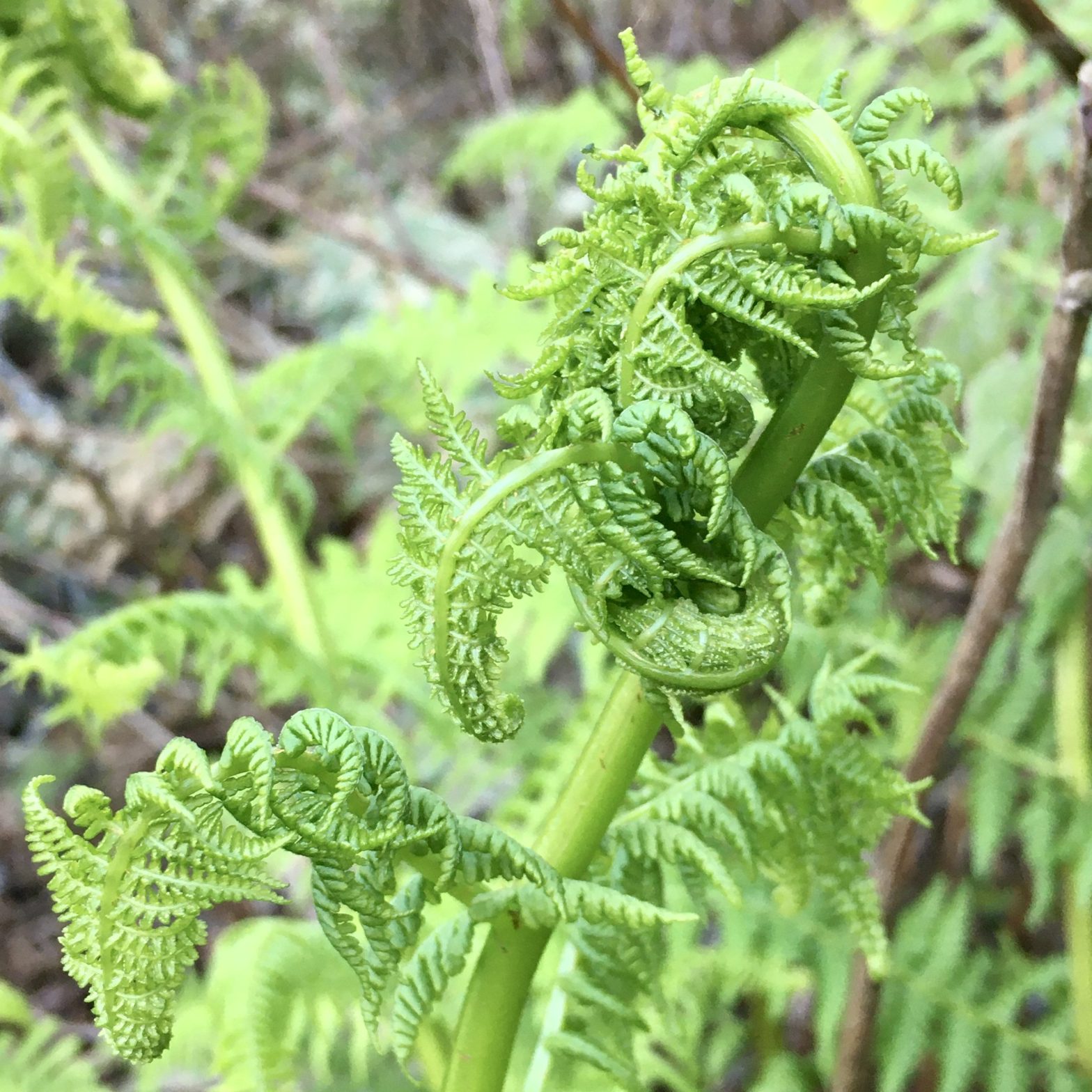
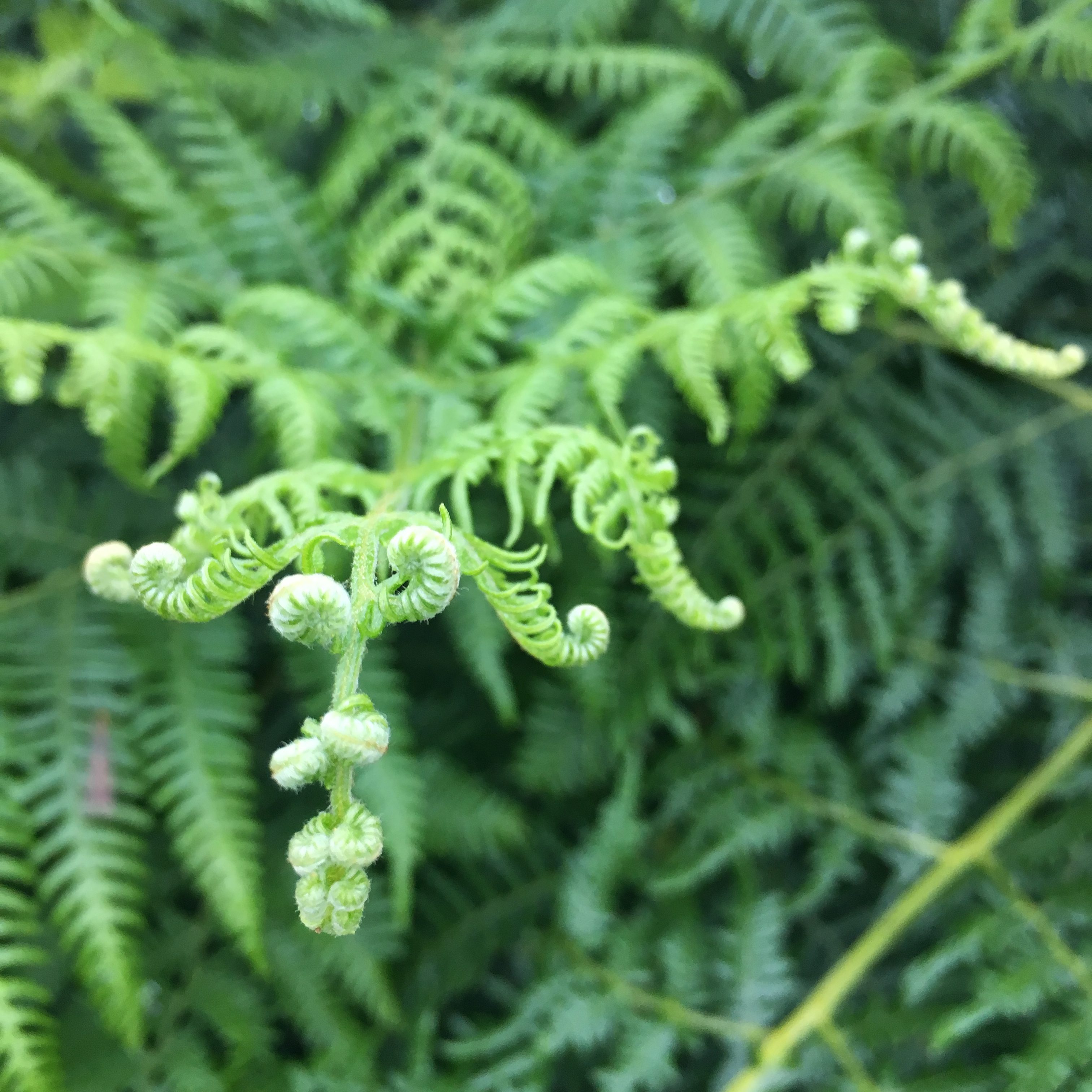
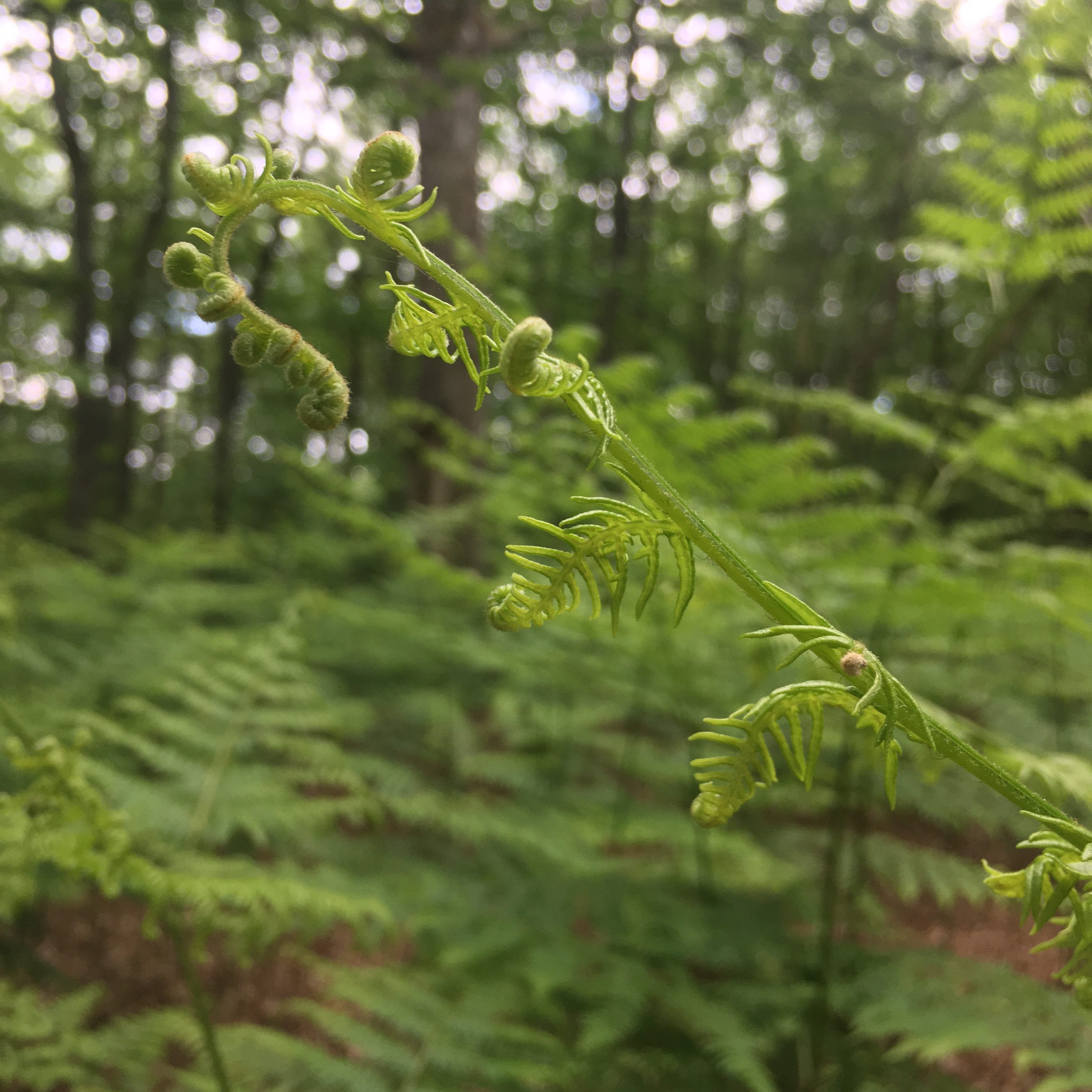
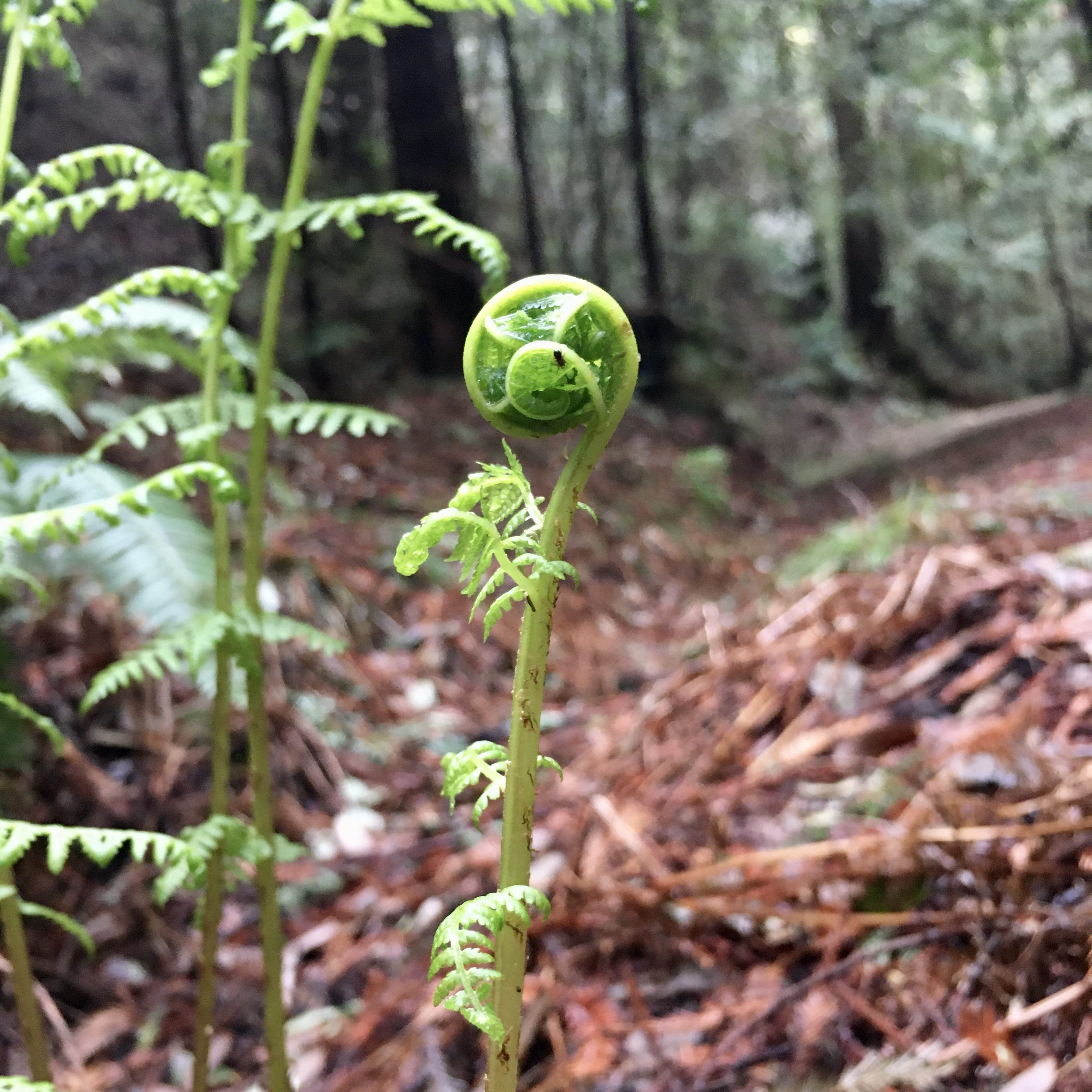
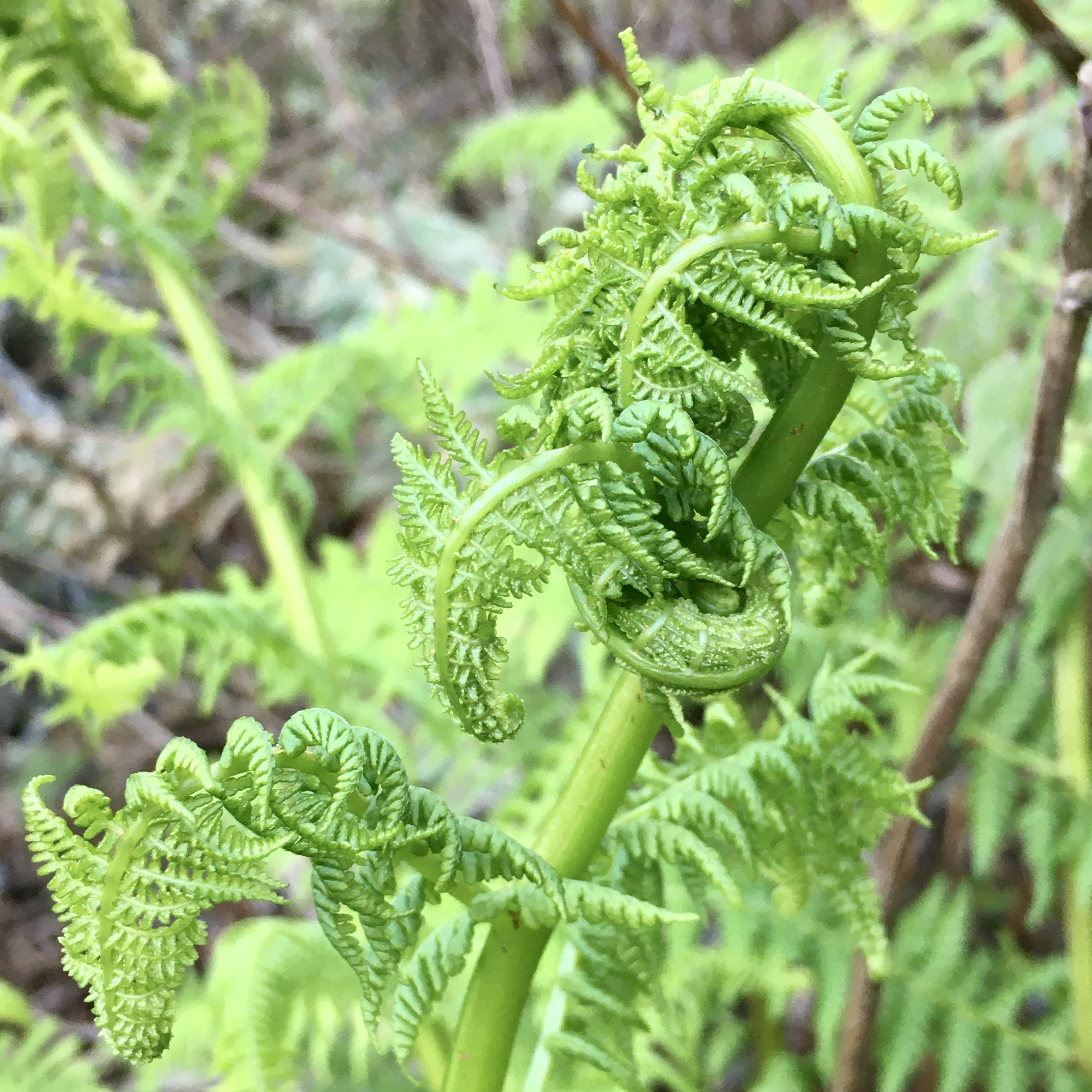
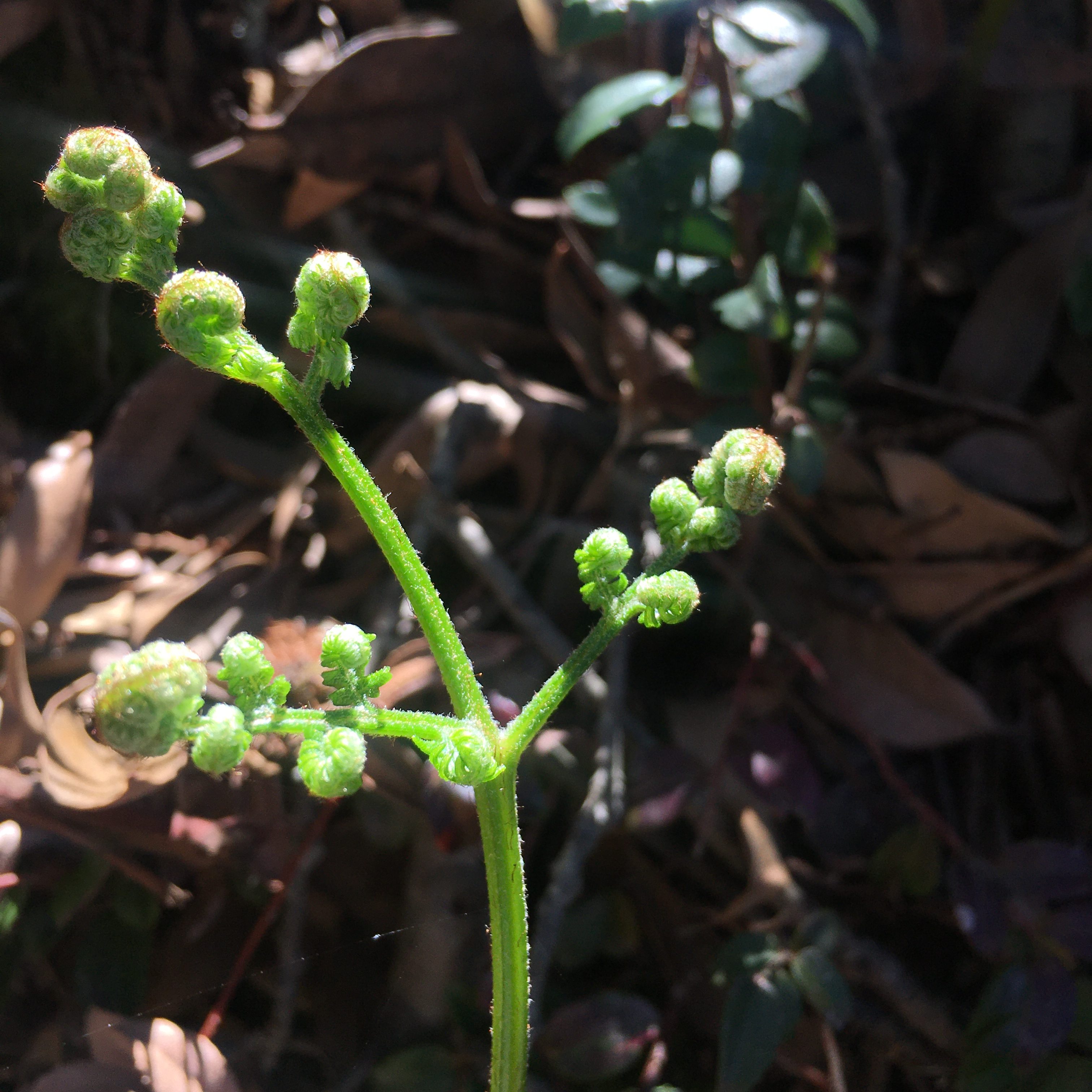
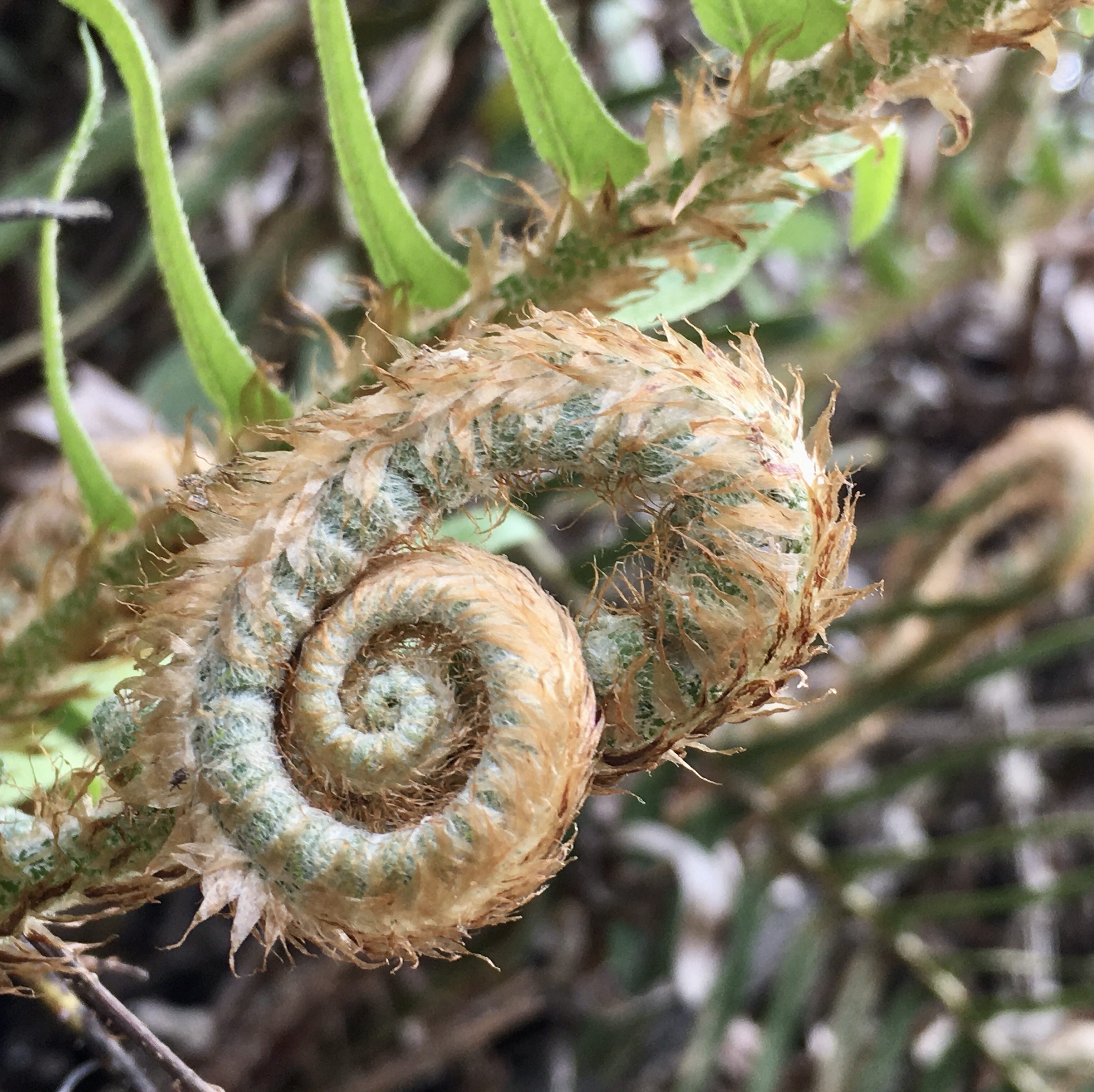
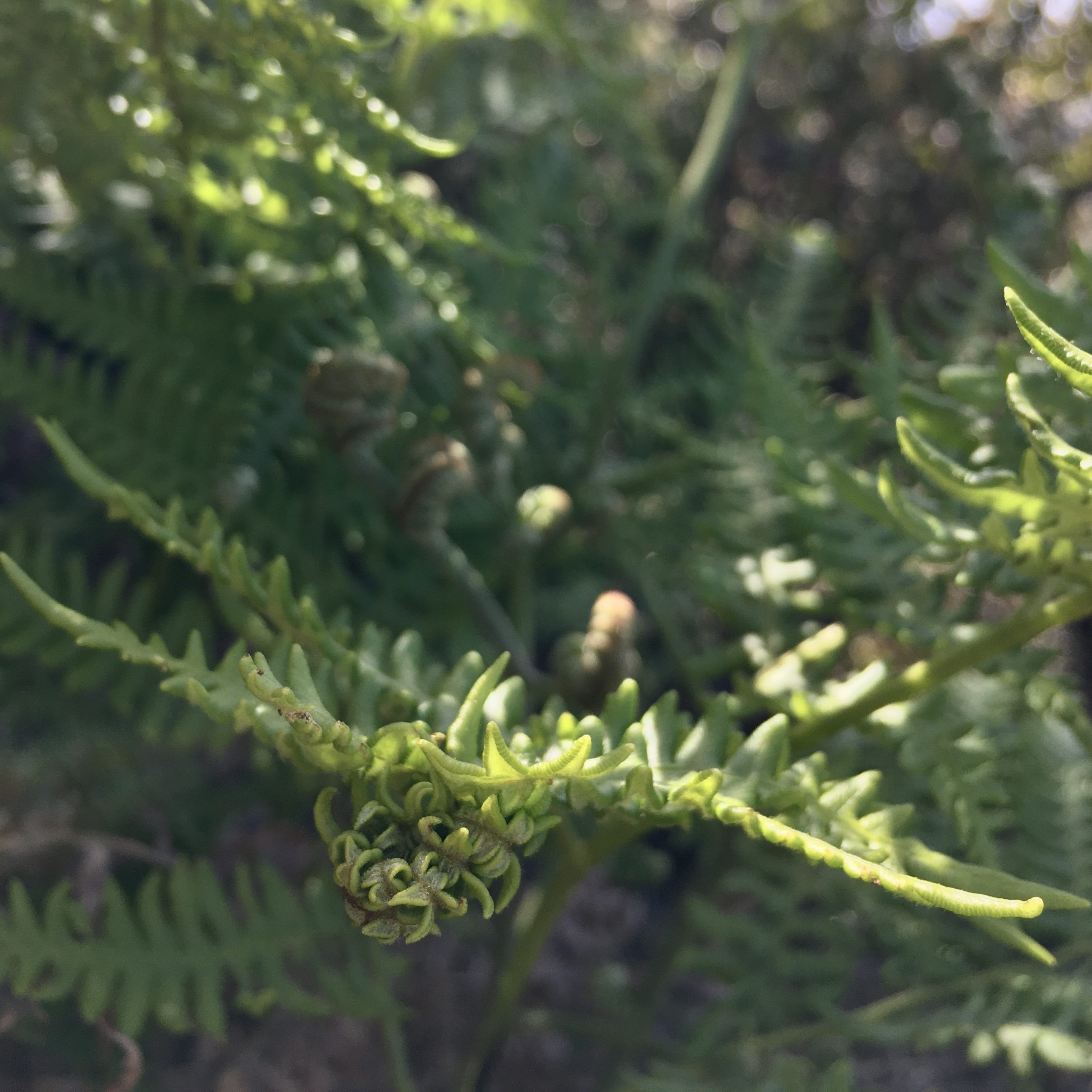
One of the most consistent sources of these teachings are ferns.

My fascination and adoration of ferns began when I first read adrienne maree brown’s book Emergent Strategy: Shaping Change, Changing Worlds. brown orients toward social movement practice through biomimicry, drawing lessons from ferns, ants, mycelium, and dandelions, among others, to guide sustainable change toward more just and equitable worlds.

Ferns grow as fractals, repeated patterns that are “self-similar across different scales.”2 Applying a fractal perspective to the realm of human relationships, this suggests that what we enact at the micro scales (intra- and interpersonally) is mirrored at the macro scales (culturally and societally), and vice versa. This can be seen through the pervasiveness of violence and injustice that are perpetuated on the macro level through, for example, legislation and cultural narratives, as well as on the micro level interpersonally through verbal and physical aggression and intrapersonally through internalized oppression.

A fractal perspective also offers opportunity to effect change. As brown offers, “what we practice at the small scale sets the pattern for the whole system.” Thus, in making intentional shifts on a small scale to live in a way that is aligned with and nurturing of a world that is more peaceful and more just, we can co-create new patterning for the whole system to reflect this transformation.

This learning resonated profoundly within me, somewhere soul deep. Humbled, inspired, and nourished by this possibility, I began to turn toward ferns with greater intention and attention. Ferns, and particularly bracken ferns, have become a source of joy, solace, and endless learning. Thus, on my walks, when ferns are in a season of emergence and unfolding, I am particularly attentive to what wisdom they might offer, always with such generosity.

gift of noticing
ferns grow in unfurling hearts
reminder of love

sunlight dappled paths
trace through trees’ growing embrace
nourishment soul deep

spiraling tendrils
unfold as fractal beings
reflecting wholeness

ferns unfolding joy
scaffolding for web makers
to weave a new home

notice this earth breath
of spring’s tender emergence
beauty grown delight

practice noticing
the spaces around the space
where new forms emerge

wounds break us open
so we may recognize our
interdependence

the shards we carry
catch reflections of shared pain
refracting wholeness

unfurling through stuckness
asks for patience with process,
faith in knowing heart

joy contains sorrow
subtle seeds of connection
from which big love grows


1 With gratitude to John Paul Lederach who has been an immense influence in my haiku practice and from whom I learned this orientation to practicing haiku.  

2 Quotes are sourced from brown, adrienne maree (2017). Emergent Strategy: Shaping Change, Changing Worlds. Chico, California: AK Press.

© 2022 All Rights Reserved

On Isolation, Identity, and Grief

The magnolia leaves outside the windows are strewn with pearls of water, traces of the afternoon’s last rain shower. The windows of the building across the courtyard stare blankly, some shuttered closed and others darkly gaping.

Not two years ago, I sat daily on the balcony just beyond these same windows, orienting my body to see a segment of sky. The magnolia leaves glinted brightly then, reflecting the sun shining down each day with unseasonal heat.

It was here that I navigated the first months of the Covid-19 pandemic, a season characterized by immense fear and uncertainty, distance and dislocation. I returned to this place less than two weeks ago and now a new strain of the coronavirus, Omicron, has begun to travel globally, the threat of renewed measures of restriction and confinement hovering on the near horizon.

These past two years in which Covid-19 has seeped with vigor and relentlessness into our lives have been filled with nuanced and heavy layers of confusion, precarity, and grief. Particularly in the early months of the pandemic, for those who were able, there was a nearly global movement to shelter in place. This movement is known under many names: confinement, isolation, lock-down, quarantine. At its core, the need was to shelter ourselves and each other from the spread of this invisible and mysterious virus. Many people were unable to shelter in this way – their employment or living arrangements such that it was impossible to not expose themselves and thus their communities to the rapidly circulating virus. Predictably, those who already incur the brunt of societies structural violences have been those disproportionately impacted by the most brutal face of the pandemic.

Many people did shift their lives to the confines of their dwelling. Some found themselves living with other people. Some found themselves living alone. For the first few weeks, some people might have experienced curiosity or even anticipation accompanying the fear and uncertainty of these days – the novelty of these new circumstances offering the opportunity to establish new habits, decreased transit time offering more space to explore new hobbies or projects. And yet, as the weeks wore on, the challenges mounted and fatigue deepened. There has been much written and documented about the difficulties of these circumstances, both in the immediacy of the experience and in the months after the initial intensity faded. To these reflections, I wish to add a wondering on isolation, on identity, on grief.

Humans are social creatures. It is only in community that we are able to survive and thrive. It is only through being in relationship with others that we become ourselves. In other words, our identities emerge from and are shaped by our relationships from the micro level of the interpersonal to the macro level of society. We might imagine our identity as a multi-faceted stone. As we inhabit different relationships, different facets of the stone are made visible. In no one relationship is the entire stone perceived. Thus, the aspects of my identity I can access when I am with Friend A are different from the aspects of me I can access when I am with Friend B, or Colleague C, or Family Member D. It is through being in a diversity of relationships that I am able to encounter, access, and express the different aspects of my identity most fully.  

By necessity, the conditions of sheltering imposed during the early phases of the pandemic (which some people continue to inhabit, or have long inhabited because of acute physical vulnerability) required a restriction of relational space. In restricting our encounters with others, we necessarily restricted our encounters with ourselves. No longer able to access the facets of ourselves that express themselves across our different relationships, we were only able access and express very limited aspects of our identity. As the toll of isolation grew, I wonder how much of this toll was and is comprised of grief – grief of self, of who we are and can be that remains hidden when we are alone or with only a few companions.

Beyond the conditions of isolation, I wonder about how this quality of grief accompanies our experiences of loss. When a relationship ends through someone’s physical death or departure, or an experience of community has culminated, our experiences of loss and grief are immensely nuanced and complex. Reflecting on the language often used to describe or explain this experience, often the weight is placed on the person or experience that is now absent (or at least not longer physically present, as they continue to live on in memory and imagination). Perhaps, another aspect of our experience of grief in this context is the grief of self. When a relationship has ended, we are no longer able to access the facet of ourselves that expressed itself in that relationship. In essence, a piece of my own identity becomes hidden and so as we grieve a person or an experience, we are also grieving the loss of access to an aspect of ourselves.

As the seasons turn, as winter descends in the northern hemisphere and summer unfolds in the southern hemisphere, nation-state borders are already starting to close and travel restrictions are increasing. Moving toward the possibility of new phases of sheltering, I pray we may be gentle with ourselves and others. In these conditions, we are not showing up as our full selves, only expressing a few facets of our complex identities. For many people, access to certain facets of themselves has been completely lost due to the death of a loved one or loved ones to the virus or other violences that have shaped these difficult years.

May we each experience the joy of plentiful encounters
And through these encounters,
Become ever more fully ourselves.
May we be gentle with ourselves,
As relationships fade and change,
Honoring all we are becoming.
May we have faith that in our grief
We are never less of who we are,
Forever shaped by each encounter.
May we live and love ourselves and each other into fullness,
Remembering we are ever changing and always whole.  

© 2021 All Rights Reserved